






National grid operates outside frequency, Voltage limits despite 85% – NERC

By Onu Okorie
Power Generation Capacity Utilisation
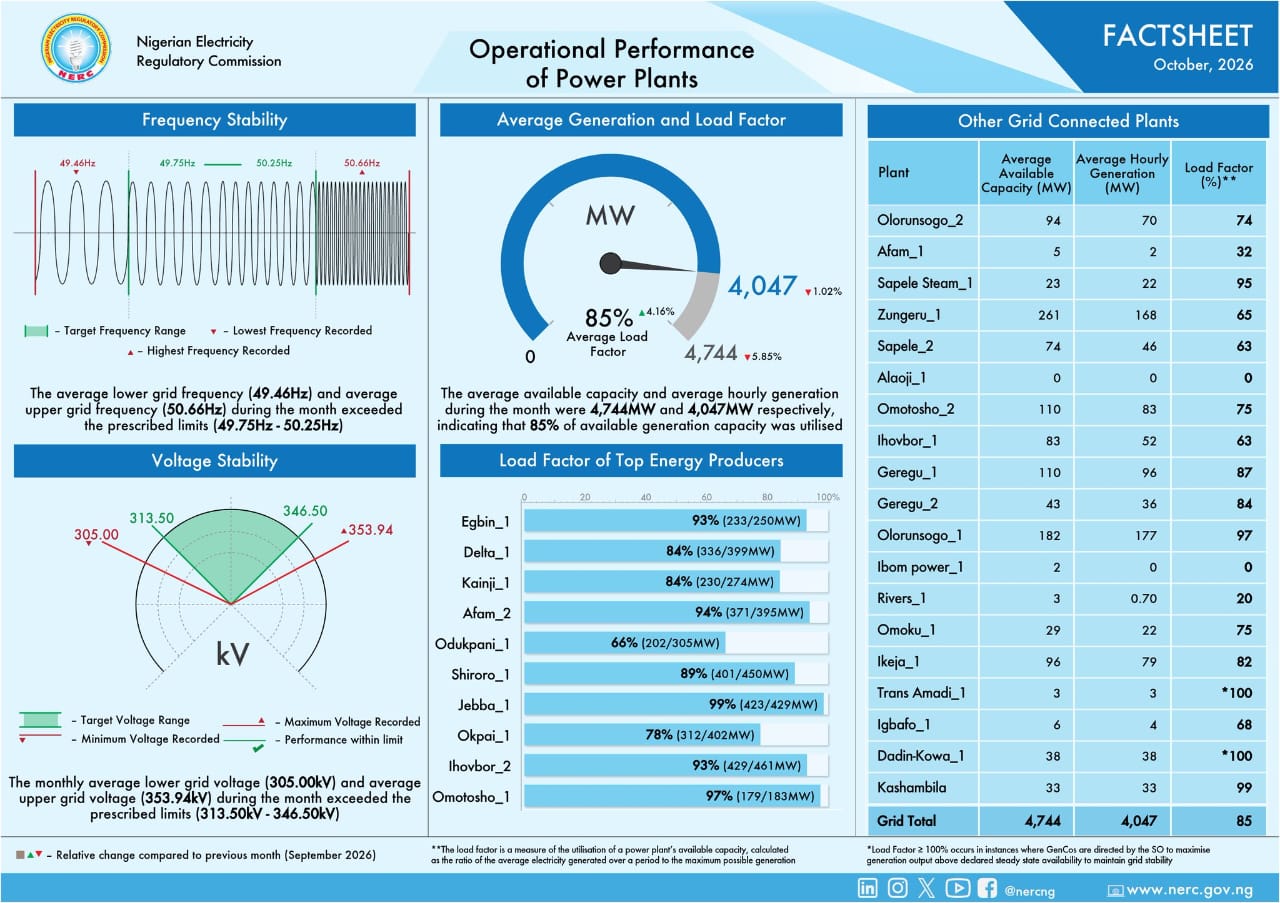
Nigeria’s national electricity grid operated outside prescribed frequency and voltage limits in October 2026, despite power plants utilising 85 per cent of their available generation capacity during the month, according to the Nigerian Electricity Regulatory Commission (NERC).
The commission disclosed this in its October 2026 Operational Performance Factsheet released on Wednesday, detailing the performance of grid-connected power plants and key operational indicators during the period.
According to the report, average available generation capacity stood at 4,744 megawatts (MW), while average hourly generation was 4,047MW, representing 85 per cent utilisation of available capacity.
NERC said the average load factor increased by 4.16 per cent during the month. However, average hourly generation declined by 1.02 per cent, while average available capacity dropped by 5.85 per cent.
Despite the level of capacity utilisation, the commission’s operational data showed that the national grid failed to maintain the prescribed frequency and voltage ranges.
On frequency stability, NERC reported that the average lower grid frequency was 49.46 hertz (Hz), while the average upper grid frequency stood at 50.66Hz.
Both figures fell outside the approved operational frequency range of 49.75Hz to 50.25Hz.
The situation was similar with grid voltage. The monthly average lower voltage was recorded at 305.00 kilovolts (kV), below the prescribed minimum of 313.50kV, while the average upper voltage reached 353.94kV, exceeding the maximum operational limit of 346.50kV.
The figures indicate that the grid experienced deviations on both ends of the prescribed frequency and voltage parameters during the review period.
A breakdown of plant performance showed that Jebba_1 recorded the highest load factor among the leading generating stations at 99 per cent, producing 423MW against an available capacity of 429MW.
Omotosho_1 followed with a 97 per cent load factor, generating 179MW out of 183MW, while Afam_2 recorded 94 per cent, with 371MW generated against an available capacity of 395MW.
Egbin_1 and Ihovbor_2 each posted load factors of 93 per cent, while Shiroro_1 recorded 89 per cent.
Delta_1 and Kainji_1 both achieved 84 per cent, while Okpai_1 recorded 78 per cent.
Odukpani_1 had the lowest load factor among the listed top producers at 66 per cent, generating 202MW against an available capacity of 305MW.
Other generating stations also recorded varying levels of performance during the month.
Olorunsogo_1 and Sapele Steam_1 posted load factors of 97 per cent and 95 per cent, respectively. Kashambila recorded 99 per cent, while Trans Amadi_1 and Dadin-Kowa_1 operated at full utilisation.
Zungeru_1 had an average available capacity of 261MW but generated 168MW, representing a load factor of 65 per cent.
Meanwhile, Alaoji_1 recorded zero available capacity and zero generation throughout the month. Afam_1 posted a load factor of 32 per cent, while Ibom Power_1 recorded no generation.
The report’s figures show that although grid-connected power plants utilised a significant proportion of their available capacity in October, the national grid continued to operate outside the regulator’s prescribed technical limits.
NERC’s monthly factsheet provides an overview of generation performance and grid operational parameters, including available capacity, actual generation, load factors, frequency and voltage levels.