




NLNG, NCDMB target commercialisation of University research with $9m endowment

By Onu Okorie
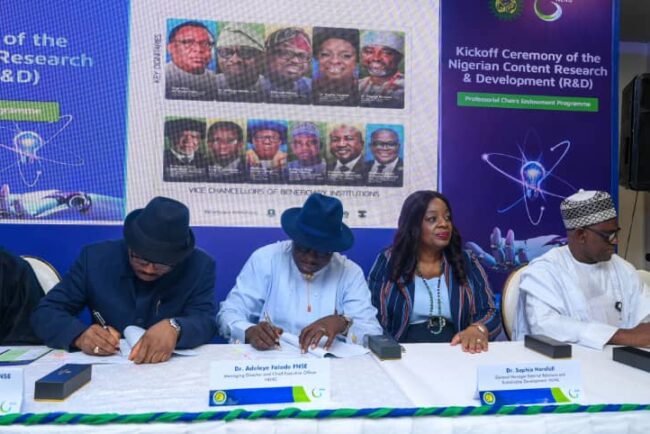
Nigeria’s efforts to bridge the longstanding gap between university research and industrial application have received a major boost, with the Nigerian Content Development and Monitoring Board (NCDMB) and Nigeria LNG Limited (NLNG) committing $9 million to establish specialised research and innovation centres in six universities across the country.
The initiative, designed to move academic research beyond publications and into commercially viable products, technologies and solutions, places Nigerian universities at the centre of efforts to address operational and technological challenges in the oil and gas industry.
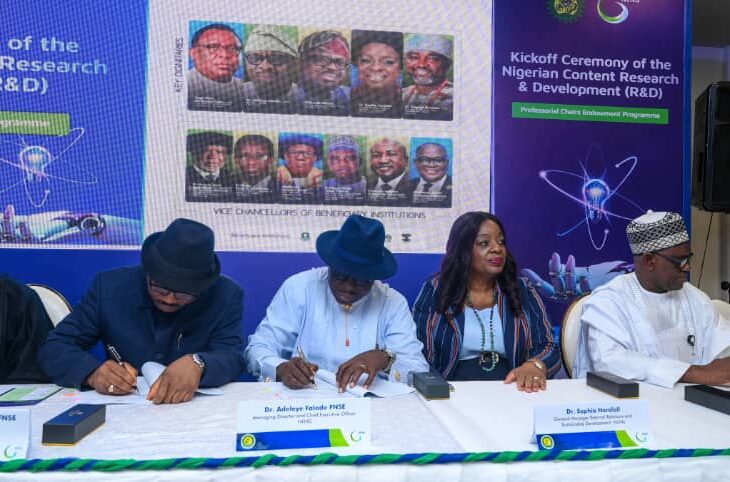
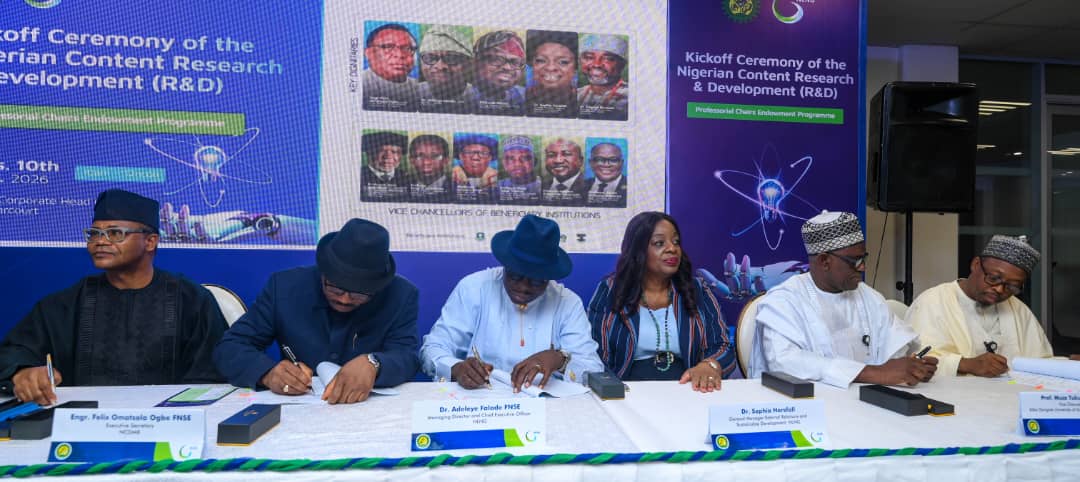
Under the Nigerian Content Research and Development (NC-R&D) Professorial Chair Endowment Programme, each of the six beneficiary institutions will receive $1.5 million to establish a specialised professorial chair dedicated to research in agreed industry priority areas.
The programme represents a strategic intervention to strengthen indigenous technological capabilities, reduce dependence on imported expertise and create a sustainable pipeline of locally developed solutions for Nigeria’s energy industry.
The beneficiary institutions are the University of Ibadan, Rivers State University, Modibbo Adama University, Yola, Aliko Dangote University of Science and Technology, Kano, University of Nigeria, Nsukka, and University of Abuja, now Yakubu Gowon University.
Speaking at the launch, NLNG Managing Director and Chief Executive Officer, Adeleye Falade, said the endowment was an investment in Nigeria’s ability to transform academic knowledge into practical solutions that can improve industrial performance and competitiveness.
In his keynote address titled, “Reshaping Nigeria’s Future Through Innovation, Research and Capacity Development,” Falade stressed that the changing dynamics of the energy industry required sustained investment in research, innovation and collaboration between government, industry and universities.
According to him, the programme would direct research towards critical industry challenges, including operational efficiency, emissions management, safety improvement, maintenance of critical infrastructure and sustainable industrial processes.
He explained that the initiative was designed around a collaborative framework involving government, industry and academia, popularly known as the triple helix model.
Under the arrangement, opportunities would be created for industry professionals to participate in specialised academic programmes, sabbaticals, exchange programmes, practical testing of research assumptions and the joint development of postgraduate curricula.
The approach is also expected to expose postgraduate students and younger researchers to real-life industrial challenges while enabling companies to benefit directly from research conducted within Nigerian universities.
Falade disclosed that the NLNG Research and Innovation Centre for Computer and Electrical Engineering (RICCEE) at Rivers State University was envisaged as the coordinating point for collaboration among the six institutions.
He said discussions were already ongoing with the university on implementation arrangements, commending its Vice-Chancellor, Professor Isaac Zeb-Obipi, for advancing the proposed partnership.
The NLNG chief executive also revealed that other technology companies, including Google, Cisco and MTN, had indicated interest in supporting the initiative, suggesting the possibility of expanding the programme beyond its initial funding partners.
He challenged the beneficiary universities to look beyond the initial endowment by attracting additional grants, building research partnerships and commercialising intellectual property.
“Expand the scope, reach for more grants and funding which can push the frontiers of knowledge and commercialisation of intellectual property,” he urged.
For the NCDMB, the initiative is part of a broader strategy to establish an integrated research and development ecosystem that connects university expertise with industry requirements and commercial opportunities.
The Executive Secretary of the Board, Felix Omatsola Ogbe, described the $9 million programme as a strategic investment in the future of Nigeria’s research and innovation landscape.
He said the professorial chair endowments complemented the Board’s existing investments in research infrastructure, particularly the establishment of specialised Research and Development Centres of Excellence across six universities.
Ogbe explained that the combination of research infrastructure, specialised academic expertise, industry participation and commercialisation opportunities would provide a stronger foundation for developing home-grown technologies.
He, however, challenged the beneficiary institutions to change their approach to academic research by moving from research primarily designed for publication to research capable of delivering practical industrial solutions.
According to him, the universities must regard the endowments as both an opportunity and a responsibility, with expectations of clearly defined research objectives, measurable outcomes, prudent resource management, effective stakeholder engagement and sustained industry collaboration.
He maintained that the ultimate expectation was for the professorial chairs to produce commercially viable solutions, strengthen indigenous technological capacity, improve industrial competitiveness and contribute to the long-term sustainability of Nigeria’s oil and gas industry.
The six universities have been assigned specialised research areas reflecting different aspects of the energy value chain and the country’s emerging technological needs.
The University of Ibadan will focus on natural gas processing, pollution control and environmental management, while Rivers State University will concentrate on digital engineering, intelligent energy systems, automation and asset integrity.
Modibbo Adama University will undertake research in energy transition and the environment, while Aliko Dangote University of Science and Technology will focus on sustainable energy innovation and climate-resilient food systems.
At the University of Nigeria, Nsukka, research will centre on green energy production and geoenvironmental engineering, while Yakubu Gowon University, Abuja, will specialise in geoscience and satellite intelligence for resilient gas infrastructure.
Each institution will operate within agreed research targets and commercialisation pathways to ensure that the programme produces measurable results rather than remaining an academic funding initiative.
The universities are also expected to jointly host an information management hub to facilitate knowledge sharing, research exchanges and collaboration among researchers.
Part of the funding will support minor civil works and infrastructure upgrades to convert designated spaces into functional research centres capable of supporting specialised investigations.
The programme will also provide opportunities for industry professionals to contribute their practical experience to academic programmes while pursuing master’s and doctoral degrees.
This arrangement is expected to strengthen the relationship between postgraduate education and industrial problem-solving, giving students access to industry knowledge while allowing companies to tap into university research capabilities.
For NLNG, the initiative also aligns with its recently approved NextGen Nigerian Content Strategy, which seeks to sustain previous Nigerian Content achievements, deepen the adoption of local content as a business principle and accelerate the transformation of indigenous capacity development.
The company’s strategy places emphasis on building local expertise, expanding opportunities for Nigerian businesses and ensuring that indigenous capabilities remain central to the development of the oil and gas industry.
Beyond the immediate $9 million commitment, the significance of the programme will ultimately depend on whether the beneficiary universities can translate research findings into technologies and solutions that can be deployed commercially.
Nigeria’s oil and gas industry has continued to grapple with technological capacity gaps, dependence on foreign expertise and the need to develop indigenous solutions for complex operational challenges.
By bringing universities closer to the industry’s practical needs, the NLNG-NCDMB partnership seeks to reposition academic research as an instrument of economic value creation, industrial productivity and technological independence.
The success of the initiative will therefore be measured not only by the quality of research produced or the number of postgraduate students trained, but also by the extent to which innovations emerging from the six institutions find application in the oil and gas industry and other sectors of the economy.
The programme reinforces the broader proposition that Nigerian Content development must extend beyond local participation in contracts to include the creation, ownership and commercial deployment of indigenous technologies.
Its guiding philosophy, as articulated by the partners, is: “Start Local, Go Global, Think Nigerian Content.”