





Nigeria sustains OPEC quota compliance for six months despite October production dip
By Onu Okorie
Nigeria has sustained its compliance with the Organisation of Petroleum Exporting Countries (OPEC) crude oil production quota for six consecutive months, reinforcing signs of improved stability in the country’s troubled upstream petroleum sector.
The latest figures were disclosed by the Nigerian Upstream Petroleum Regulatory Commission NUPRC’s Head of Media and Corporate Communications, Eniola Akinkuotu.
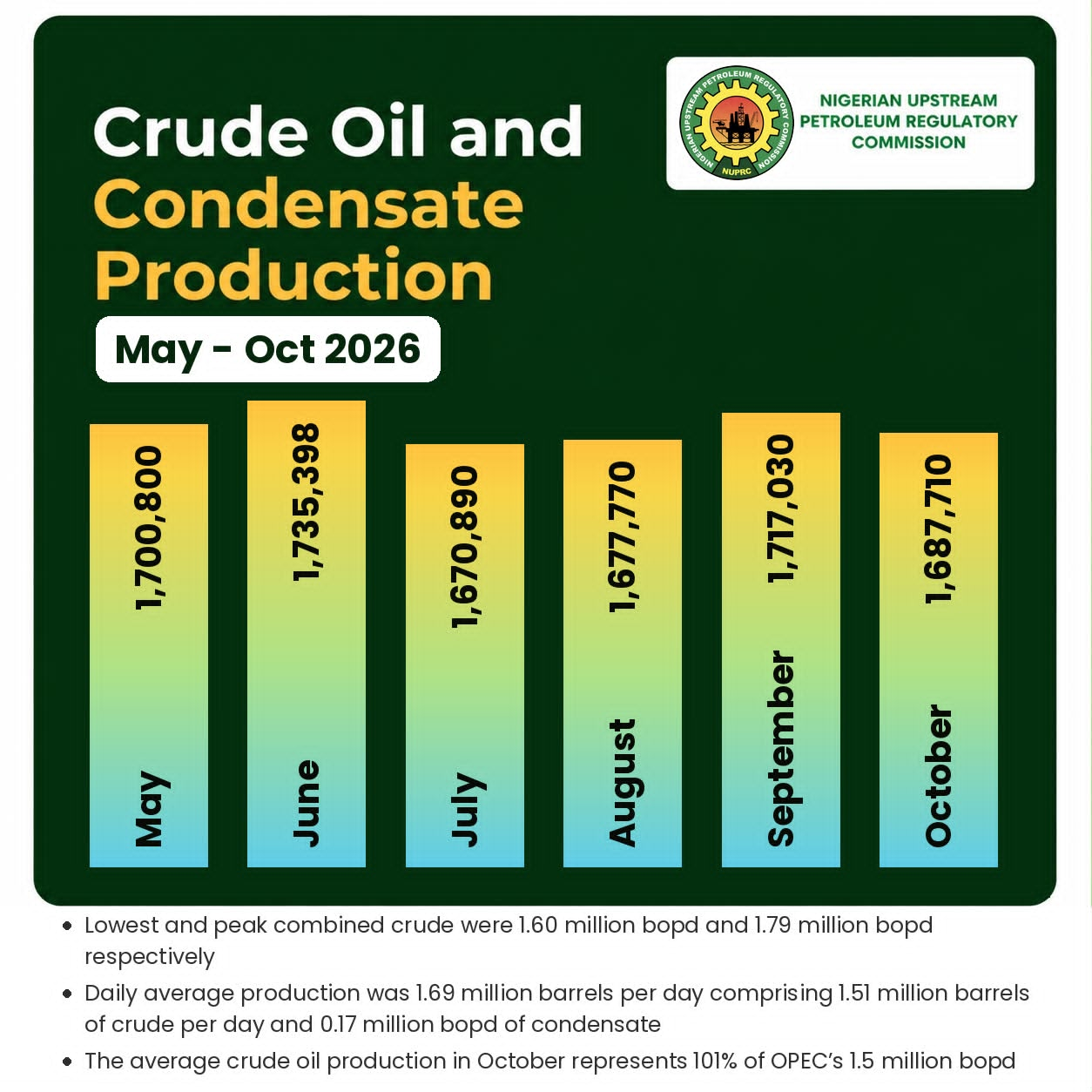
The figures show that the country produced an average of 1.51 million barrels per day (mbpd) of crude oil in October 2026, slightly above its OPEC-assigned quota of 1.5 million barrels per day.
The performance represents 101 per cent compliance with the production benchmark, extending a six-month streak that began in May and suggesting that efforts to improve production reliability, operational efficiency and crude evacuation are yielding results.
However, the achievement came against the backdrop of a 1.7 per cent month-on-month decline in total production, indicating that Nigeria’s recovery remains vulnerable to operational disruptions and other upstream challenges.
According to the NUPRC data, Nigeria recorded an average daily production of 1,687,710 barrels of crude oil and condensate in October, while production peaked at 1.79 million barrels on the highest-producing day and dropped to 1.60 million barrels on the lowest.
The distinction between crude oil and condensate remains important in assessing the country’s compliance with OPEC obligations, as the organisation’s production benchmark is measured against crude oil output, excluding condensates.
A review of the country’s production performance between May and October shows that Nigeria has consistently maintained output at or above its assigned quota.
Crude oil production stood at 1.53 million barrels per day in May, increased to 1.55 million barrels in June, before moderating to 1.51 million barrels in July.
Production subsequently settled at 1.5 million barrels per day in August, rose to 1.53 million barrels in September and stood at 1.51 million barrels in October.
The six-month performance represents a significant development for Nigeria, which has struggled in previous years to consistently meet its OPEC production allocation amid crude oil theft, pipeline vandalism, ageing infrastructure, operational setbacks and difficulties evacuating crude from producing fields.
The NUPRC attributed the relatively stable production performance to improved operational stability, increased production uptime and greater efficiency in crude oil evacuation.
The commission also credited the sustained output to the commitment of operators and other industry stakeholders to improving operational efficiency, maintaining asset integrity and strengthening production reliability across the upstream petroleum industry.
A breakdown of October’s production by terminals and streams showed that Forcados Terminal emerged as the country’s largest contributor, recording an average daily output of 318.49 thousand barrels of crude oil and condensate.
Bonny Terminal followed with 311.02 thousand barrels per day, while Qua Iboe Terminal accounted for 173.97 thousand barrels.
Escravos Oil Terminal recorded 134.67 thousand barrels per day, while Bonga ranked fifth with an average production of 106.65 thousand barrels per day.
The terminal figures underscore the importance of Nigeria’s major production hubs to national output and the need to sustain investments in infrastructure, operational security and evacuation networks.
Beyond the immediate achievement of meeting its OPEC quota, maintaining production above the 1.5 million barrels per day threshold has important implications for government revenue, foreign exchange earnings and the country’s capacity to meet domestic and international crude supply obligations.
Nevertheless, the October decline highlights the need to consolidate recent improvements rather than regard quota compliance as evidence that the industry’s production challenges have been fully resolved.
For Nigeria, the bigger test will be whether the current production stability can be sustained and translated into higher output, particularly as the Federal Government pursues its ambition of increasing crude oil production and strengthening the contribution of the petroleum sector to economic growth.