



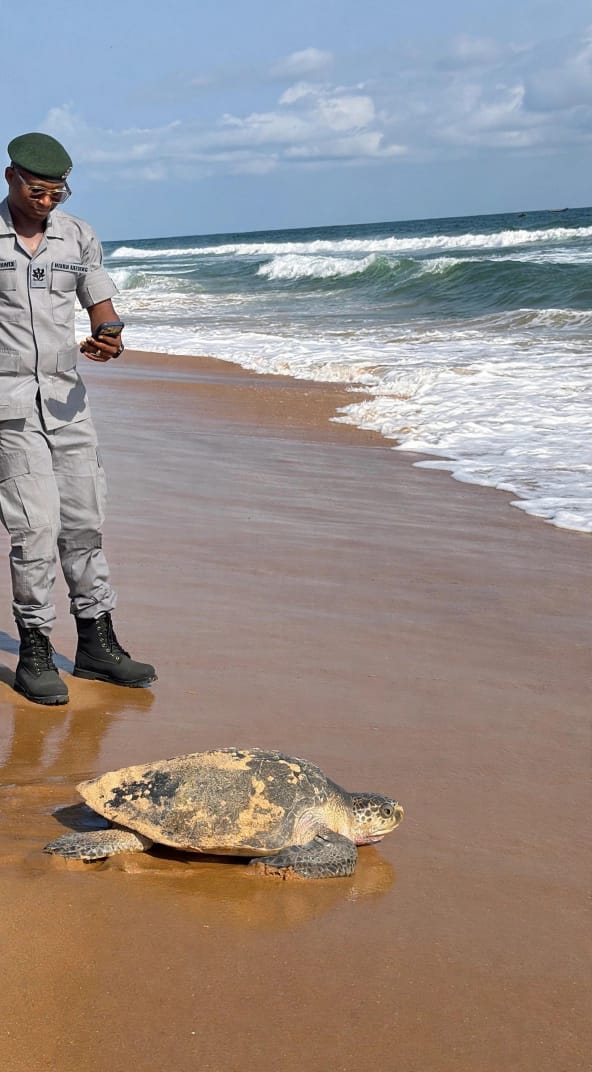
Customs intercepts endangered Sea turtle at Seme border, decries wildlife trafficking

By Onu Okorie
The growing use of Nigeria’s porous land borders for the illegal movement of endangered wildlife has come under renewed scrutiny following the interception of a live Pacific Ridley Sea Turtle by the Nigeria Customs Service (NCS) at the Seme border.
The interception, which highlights the expanding environmental security responsibilities of the Customs Service, occurred on Thursday night, November 12, when officers on routine patrol along a footpath linking Nigeria and the Republic of Benin discovered an abandoned sack containing the endangered marine animal.
The suspect, who reportedly abandoned the sack and escaped into a nearby bush after sighting the patrol team, remains at large.
The discovery has brought fresh attention to wildlife trafficking as an emerging dimension of cross-border organised crime, with implications for biodiversity conservation, border security and Nigeria’s compliance with international environmental protection obligations.
The animal, identified as the Pacific Ridley Sea Turtle, also known as the Olive Ridley Sea Turtle (Lepidochelys olivacea), was immediately secured by Customs officers and subsequently handed over to relevant wildlife authorities for care, rehabilitation and eventual release into its natural habitat.
The operation was carried out by officers of the Seme Customs Area Command during a routine patrol at about 10.30pm.
Beyond the seizure itself, the incident underscores the challenges confronting border authorities in preventing the exploitation of Nigeria’s land borders by criminal networks involved in the illegal capture, transportation and commercial exploitation of protected wildlife.
Wildlife trafficking is a lucrative transnational criminal activity that threatens vulnerable animal populations, disrupts ecosystems and undermines conservation efforts. Sea turtles, particularly the Olive Ridley species, are targeted for their meat, eggs and shells, as well as for traditional medicinal purposes and the exotic pet trade.
The interception also raises questions about the extent to which wildlife trafficking networks exploit informal border routes to evade conventional customs controls.
Nigeria has international and domestic legal obligations to prevent the illegal exploitation and trade of endangered species.
The country is a signatory to the Convention on International Trade in Endangered Species of Wild Fauna and Flora (CITES), adopted in 1973 to ensure that international trade in wild animals and plants does not threaten their survival.
The convention is domesticated through the Endangered Species (Control of International Trade and Traffic) Act, Cap E9, Laws of the Federation of Nigeria, 2004, which criminalises unauthorised hunting, capture, possession, trade, importation and exportation of endangered species.
The Nigeria Customs Service Act, 2023, also provides the Service with the statutory framework to enforce relevant import and export regulations, including the suppression of smuggling and illicit wildlife trade.
Speaking on the interception, the Acting Customs Area Controller of Seme Command, Deputy Comptroller Norman Olisah Alumanah, said the operation demonstrated the vigilance, discipline and professionalism of officers deployed to protect the country’s borders.
He maintained that the Service would not allow Nigeria’s borders to become corridors for wildlife trafficking, warning smugglers, poachers and their collaborators against engaging in the illegal trade.
Alumanah attributed the Command’s growing enforcement capacity to the operational support and logistics provided by the Comptroller-General of Customs, Bashir Adewale Adeniyi, and the management of the Service.
He also called on residents of border communities to provide credible intelligence to security agencies, stressing that the fight against wildlife trafficking could not be won through enforcement operations alone.
According to him, the Command has intensified patrols, surveillance and intelligence gathering across its area of responsibility, while planning increased stakeholder education and sensitisation on endangered species, their ecological importance and the legal consequences of their unauthorised exploitation.
The latest interception further expands the traditional responsibilities of the Customs Service beyond revenue collection, trade facilitation and suppression of conventional smuggling to include environmental protection and the enforcement of international conservation commitments.
It also reinforces the need for stronger collaboration between Customs, wildlife conservation agencies, border communities and other relevant institutions to dismantle trafficking networks and prevent Nigeria from becoming a transit route for endangered species.
For the Seme Command, the successful recovery of the turtle represents more than another enforcement achievement. It is a reminder that border security must increasingly incorporate environmental intelligence and the protection of threatened species.
The challenge, however, will be to move beyond isolated interceptions towards identifying the networks, financiers and cross-border collaborators behind the illegal wildlife trade.
The Customs Service has reiterated its commitment to protecting Nigeria’s biodiversity and ensuring that the country’s borders are not exploited for activities that threaten its environmental heritage and sustainable development.