

TCN expands Katsina power capacity as Tegbe commissions Kankia transformers, begins Mashi substation

TCN expands Katsina power capacity as Tegbe commissions Kankia transformers, begins Mashi substation

By Onu Okorie
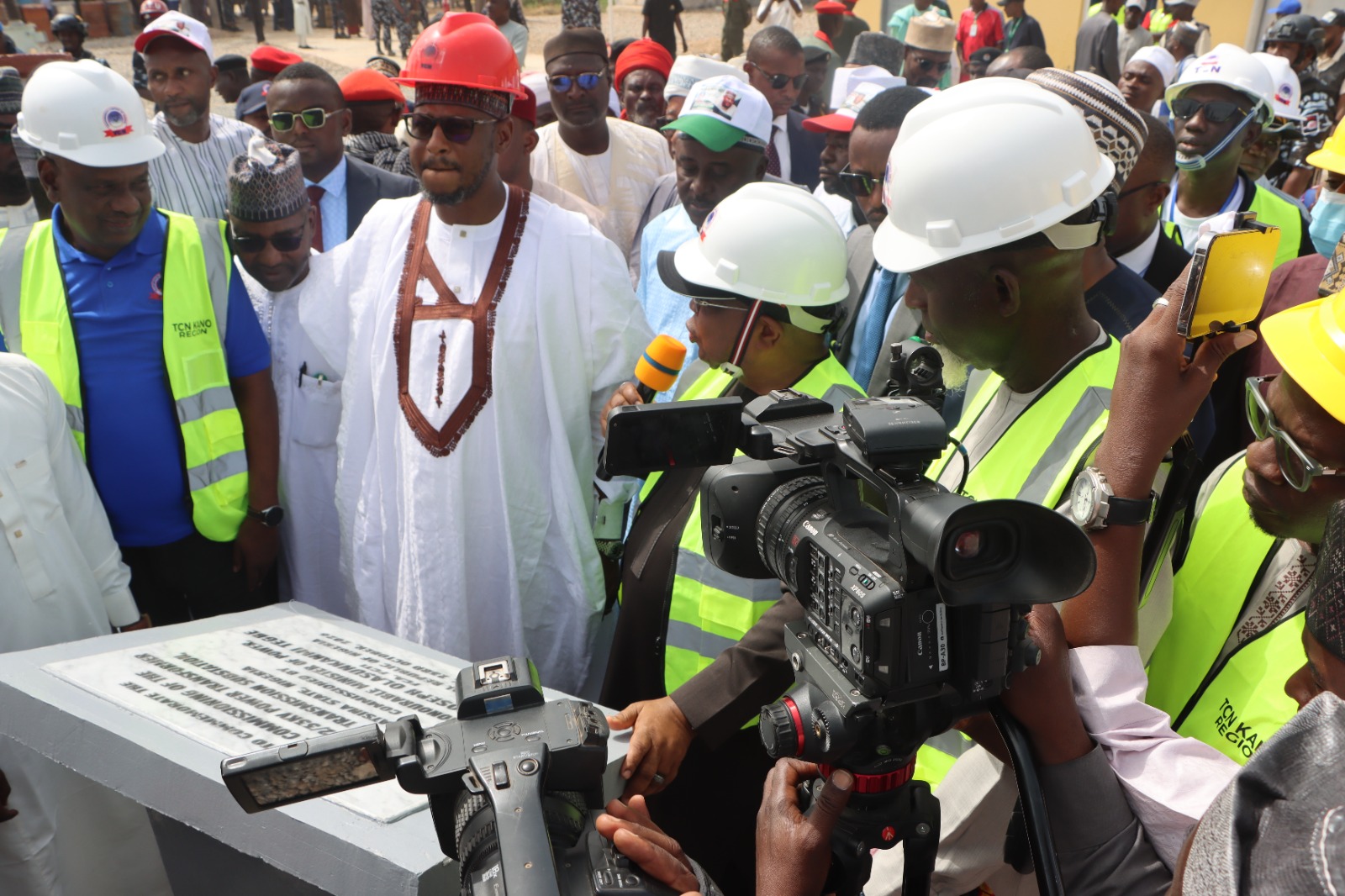
The Federal Government has stepped up efforts to address electricity supply constraints in Katsina State with the commissioning of two 60MVA power transformers at the Kankia Transmission Substation and the commencement of a new 120MVA facility in Mashi.
The projects, undertaken by the Transmission Company of Nigeria (TCN), are expected to strengthen the transmission network, increase bulk electricity supply to distribution companies and improve power availability in communities across the state.
Minister of Power, Joseph Tegbe, who commissioned the Kankia transformers and performed the groundbreaking ceremony for the Mashi substation, said the interventions were designed to address capacity limitations and provide infrastructure to accommodate growing electricity demand.
At Kankia, the installation of two 60MVA, 132/33kV transformers has raised the substation’s installed transformation capacity from 60MVA to 150MVA, representing a 150 per cent increase, according to the minister.
The additional capacity is expected to provide room for previously unmet electricity demand and improve bulk power supply to the Kano Electricity Distribution Company (KEDCO) for onward distribution to consumers.
Tegbe said the project demonstrated the Federal Government’s commitment to expanding critical infrastructure under President Bola Tinubu’s Renewed Hope Agenda.
He noted that investments in the power sector should translate into improved economic opportunities, stronger productive activities and better living conditions for Nigerians.
The Kankia project was funded by the World Bank and implemented through the Federal Ministry of Power and TCN, with China Energy Engineering Group Jiangsu Power Design Institute serving as contractor.
TCN Managing Director, Sule Ahmed Abdulaziz, said the upgrade became necessary as electricity demand increased across the areas served by the substation.
He explained that Kankia was initially equipped with two 30MVA transformers, providing a combined capacity of 60MVA, equivalent to approximately 48MW.
However, rising demand within KEDCO’s distribution network placed pressure on the available transformation capacity, resulting in suppressed load and limiting the substation’s ability to accommodate additional electricity requirements.
Abdulaziz said the project involved more than the installation of new transformers, adding that the control room had been expanded to accommodate digital control and protection panels in place of the previous analogue systems.
The 33kV busbar system was also expanded, while additional outgoing feeders were installed to improve operational flexibility and strengthen the substation’s control and protection infrastructure.
According to him, the improvements are expected to ease electricity supply constraints in Kankia, Dutsinma, Danbatta and Musawa by increasing the volume of bulk power available for distribution.
Mashi Gets New 120MVA Transmission Substation
In a related development, the Federal Government has commenced work on a new 2 × 60MVA, 132/33kV transmission substation in Mashi, designed to provide a combined transformation capacity of 120MVA, equivalent to approximately 96MW, upon completion.
The project is expected to improve electricity supply to Mashi and neighbouring communities, where residents have experienced inadequate power supply and poor voltage levels.
Performing the groundbreaking ceremony, Tegbe said the project was intended to bring electricity infrastructure closer to communities and support their economic development.
“Today, we break ground in Mashi with a clear purpose: to build electricity infrastructure that supports livelihoods and gives this community greater room to grow,” he said.
The minister disclosed that issues relating to wayleave and compensation had been satisfactorily resolved, paving the way for construction, with completion scheduled for March 31, 2027.
He urged TCN, the contractor and supervising engineers to ensure that the project was delivered within the stipulated timeframe and in accordance with safety and quality standards.
Tegbe also commended Katsina State Governor, Dikko Umar Radda, for his support and collaboration with the Federal Government on infrastructure development.
Abdulaziz described the Mashi project as a response to longstanding electricity challenges affecting households, businesses, agricultural activities and public services in the area.
He said inadequate power supply and poor voltage levels had affected residents’ daily activities, including the preservation of farm produce and the operation of small businesses.
The new substation, he added, would bring additional transformation capacity closer to consumers through KEDCO while providing room for future growth in electricity demand.
The TCN managing director called on community leaders and residents to support the project and protect the infrastructure against vandalism.
He said the benefits of the facility would ultimately depend on its impact on people’s lives, including its potential to stimulate economic activities, support employment and expand opportunities for young people.
Katsina Town GIS Project Underway
Beyond Kankia and Mashi, Tegbe also inspected the ongoing construction of a 2 × 100MVA, 132/33kV gas-insulated switchgear (GIS) transmission substation in Katsina town.
The facility is designed to provide 200MVA of installed transformation capacity, equivalent to approximately 160MW, upon completion.
It comprises two 100MVA power transformers, gas-insulated switchgear, protection and control systems, and associated civil and electrical infrastructure.
The GIS technology is designed to optimise space utilisation while supporting safe and reliable substation operations.
When completed, the project is expected to strengthen the transmission network supplying KEDCO and increase the capacity available for distribution across Katsina town and neighbouring communities.
Together, the three interventions represent an expansion of transmission infrastructure in Katsina State, combining additional capacity at an existing substation, the construction of a new facility and the development of a major urban transmission project.
However, the extent to which the investments will improve electricity supply to households and businesses will also depend on the capacity of distribution infrastructure to deliver the additional power to end users.