

Abuja-Kano highway: FG completes 118km Lot 1 with ₦252bn, says Umahi

….extends corridor to Kano airport, deploys concrete pavement, CCTV
….as 30.58km outstanding sections open to traffic

By Onu Okorie
Federal Government has stepped up efforts to clear the backlog of inherited road projects, commissioning another 30.58 kilometres of the Abuja–Kaduna–Zaria-Kano Expressway after terminating an earlier contract over rising costs and slow execution.
The development provides a fresh boost to one of Nigeria’s busiest economic corridors, which links the Federal Capital Territory with major agricultural, industrial and commercial centres across the North-West.
Minister of Works, Senator David Umahi, said substantial sections of the highway were still outstanding when President Bola Tinubu assumed office, prompting the government to restructure the project and prioritise completion of the unfinished portions.
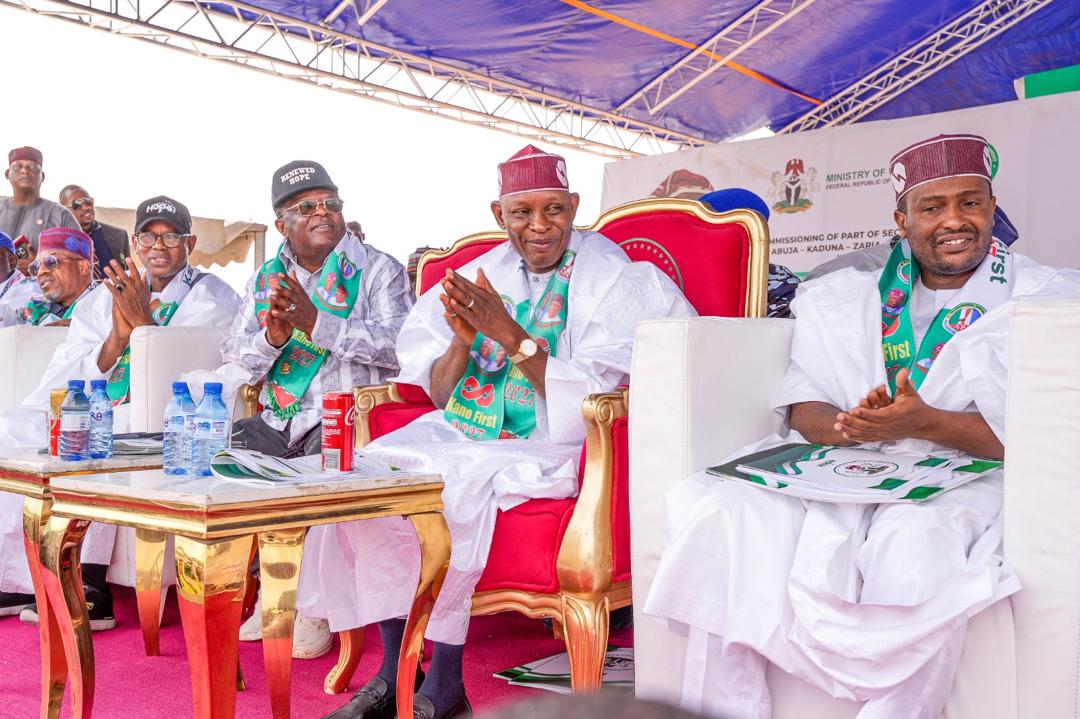
The newly completed works, commissioned in Kano on Wednesday by Governor Abba Kabir Yusuf on behalf of the President, include asphalt pavement, drainage and road structures as well as streetlights and CCTV infrastructure.
Umahi disclosed that Lot 1 of the highway, covering 118 kilometres, had now been completed at an estimated cost of ₦252 billion.
The government has also expanded the original scope of the project, with Tinubu directing that the Kano end be extended to the Malam Aminu Kano International Airport.
The move is expected to strengthen the highway’s role as a major logistics artery, connecting businesses, farms and population centres to Kano, one of Nigeria’s largest commercial hubs, while improving access to the international airport.
Umahi said the intervention represented the administration’s determination to complete critical projects inherited from previous governments rather than allow them to deteriorate into abandoned infrastructure.
He explained that escalating project costs and slow construction had contributed to the termination of the previous contract before the Federal Ministry of Works adopted a new approach to completing the corridor.
According to him, the government has introduced continuously reinforced concrete pavement on substantial portions of the expressway as part of efforts to extend the road’s lifespan and reduce recurrent maintenance expenditure.
Solar-powered streetlights are also being deployed to improve nighttime visibility and safety.
Describing the Abuja–Kaduna–Zaria-Kano highway as a strategic national asset, Umahi said its economic relevance extended beyond the North-West because of the volume of passengers, agricultural commodities and manufactured goods moving through the corridor.
“Its importance extends beyond the North-West Zone, as it supports trade, commerce, haulage and other economic activities, and social interaction, across the country,” the minister said.
The Director, Highways, Construction and Rehabilitation at the ministry, David Yiltong, said the latest intervention comprised completed asphalt pavement at the Kano end and another section along the Karfi and Kunkumi axis, bringing the commissioned length to 30.58 kilometres.
Yiltong said improvements on the corridor would reduce travel discomfort, improve traffic flow and strengthen access to communities and commercial centres.
The Engineer’s Representative, Chukwuma Kalu Igwe, said the scope covered pavement construction and rehabilitation, asphalt surfacing, drainage works, improvements to road structures, streetlights, CCTV cameras and associated infrastructure.
Governor Yusuf said completion of the outstanding sections would strengthen transportation links between Kano and neighbouring states while supporting commerce and the movement of people and goods.
He praised the Federal Government for choosing to complete the project rather than allowing unfinished portions inherited from previous administrations to remain abandoned.
Beyond the Abuja-Kano corridor, Umahi said the government was simultaneously pursuing several major highways across the North-West, including the Sokoto–Badagry Superhighway, Kano Northern Bypass, Kano–Katsina road, Zaria–Funtua-Gusau-Sokoto corridor and Section I of the Kano-Maiduguri road dualisation.
The projects form part of a broader Federal Government strategy to improve interstate connectivity and lower transportation constraints on economic activities.
Minister of State for Works, Bello Muhammad Goronyo, said completion of inherited projects demonstrated the political will of the Tinubu administration to tackle longstanding infrastructure deficits.
Director Overseeing the Office of the Permanent Secretary in the ministry, Muhammed Aminu Ahmed, also said road infrastructure remained critical to economic growth, employment creation and national integration.
As part of the commissioning activities, Umahi inaugurated two roads constructed by the Kano State Government — the rehabilitated Audu Bako Way and the dualised Nassarawa Hospital roads — which are expected to complement the federal highway by improving traffic movement within Kano metropolis.
Meanwhile, the Emir of Daura, Alhaji Faruk Umar Faruk, said the continuation of projects initiated under previous governments, including the administration of the late President Muhammadu Buhari, showed that infrastructure development should transcend political administrations.
He dismissed claims that the Tinubu government was working against the interests of Northern Nigeria and said ongoing federal infrastructure projects in the region demonstrated otherwise.
Umahi, who also linked the administration’s infrastructure programme to the 2027 political contest, urged Nigerians to support continuity, saying President Tinubu “rightly deserves our votes to continue the good works.”
The Federal Ministry of Works said it would continue efforts to complete ongoing highway projects across the six geopolitical zones, arguing that stronger road links are essential to reducing transportation bottlenecks, expanding commerce and deepening economic integration.