




DBN mulls women financing as $61m AfDB facility targets business growth

DBN mulls women financing as $61m AfDB facility targets business growth

By Onu Okorie
Development Bank of Nigeria has moved to overhaul the traditional financing model for women-owned businesses, combining loans with credit guarantees, grants and access to markets as high borrowing costs continue to squeeze small enterprises across the country.
The intervention signals an acknowledgement that increasing the supply of credit alone may not be enough to keep businesses alive or enable them to expand under Nigeria’s difficult operating environment.
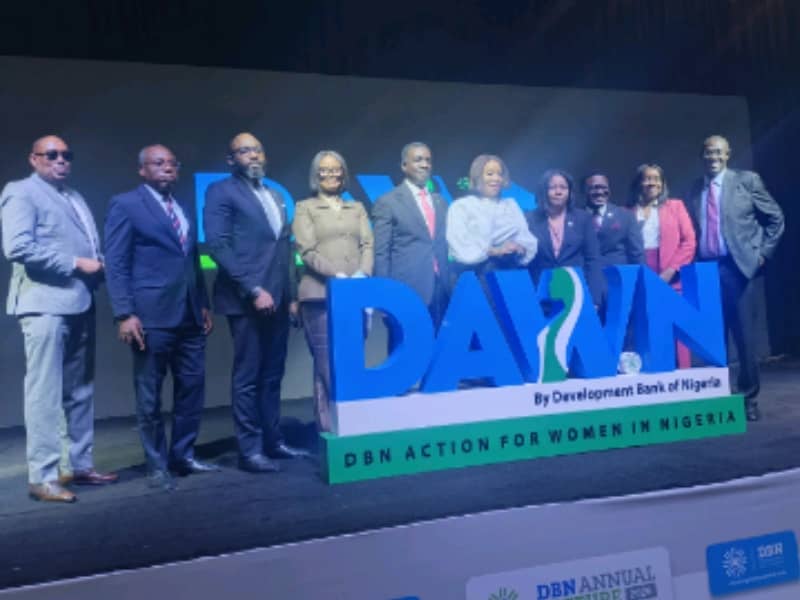
At its seventh annual lecture in Abuja, DBN unveiled the DBN Action for Women in Nigeria (DAWN), a programme designed to tackle several of the obstacles preventing women-led enterprises from growing beyond the micro and small-business level.
The initiative coincided with the signing of a $61 million gender-focused credit line between DBN and the African Development Bank (AfDB), which is expected to provide additional financing for female entrepreneurs.
Unlike conventional intervention programmes centred mainly on loans, DAWN will combine financing with partial credit guarantees, technical assistance, outcome-linked grants and direct market connections.
The programme is expected to link participating entrepreneurs with potential customers, trade platforms and business associations, potentially addressing one of the less-discussed problems confronting MSMEs — finding sustainable markets after obtaining financing.
DBN Managing Director and Chief Executive Officer, Dr Tony Okpanachi, said the institution was attempting to move gender financing from policy commitments towards measurable business outcomes.
“DAWN is about moving gender-focused lending beyond intention and turning access into opportunity,” Okpanachi said.
He argued that experience had shown that access to credit, without the wider ecosystem required to support businesses, was insufficient to guarantee sustainable expansion.
The $61 million AfDB facility is expected to provide part of the financial firepower for the programme as DBN attempts to narrow the financing gap facing women entrepreneurs.
However, details of the interest rates, disbursement timetable and number of businesses expected to benefit from the facility were not immediately disclosed.
DBN operates primarily as a wholesale development finance institution, channeling funds to MSMEs through participating financial institutions rather than lending directly to most businesses.
The effectiveness of the latest intervention could therefore depend partly on how quickly participating lenders transmit the financing to businesses and the conditions attached to accessing the funds.
This comes at a time when high borrowing costs and collateral requirements have made commercial credit increasingly difficult for many small businesses to obtain.
Okpanachi consequently challenged financial institutions to reconsider rigid collateral requirements and develop lending structures that allow viable small enterprises to access financing.
But he also placed responsibility on business owners, urging entrepreneurs to formalise their operations and maintain proper financial records to improve their ability to attract institutional financing.
DBN said it would further use partial credit guarantees provided through its subsidiary, Impact Credit Guarantee Limited, to reduce the risks faced by lenders financing smaller businesses.
The guarantees are intended to encourage financial institutions to lend to enterprises that may be commercially viable but unable to satisfy traditional collateral demands.
DAWN will also draw on capacity-building programmes, including DBN’s Entrepreneurship Training Programme, as the institution seeks to combine capital with management and business-development skills.
The new initiative builds on DBN’s wider MSME financing operations. As of December 2025, the bank said it had cumulatively disbursed ₦1.4 trillion to micro, small and medium enterprises through 84 participating financial institutions.
It said the interventions had supported approximately 1.6 million jobs nationwide.
Under its new five-year strategy, DBN is targeting more than two million MSMEs, with specific attention to women-led enterprises, youth-owned businesses and companies operating in underserved states.
The bank also unveiled its MSME Data Assets, an open-data resource expected to support research and evidence-based policymaking, alongside its latest Impact Report on the outcomes of its interventions.
The seventh annual lecture, themed, “From Policy to Prosperity: Translating Economic Reforms into MSME Growth,” also brought the impact of Nigeria’s broader economic reforms on small businesses into focus.
Representing the Secretary to the Government of the Federation, Mrs Augusta Warrens Bekaredebo said the Federal Government’s 2026 tax reforms were expected to provide relief and exemptions for eligible small businesses.
She argued that the success of economic reforms should ultimately be judged not merely by improvements in headline economic indicators but by whether businesses survive, production expands and jobs are created.
For DBN, that challenge will also provide a test for DAWN.
While the $61 million AfDB credit line increases the pool of capital available for women entrepreneurs, the bigger question is whether the combination of cheaper financing, guarantees, grants, business support and market access can overcome the structural obstacles that have prevented many women-owned enterprises from moving from survival to sustainable growth.