



CNG forum pushes mass vehicle conversion, financing as fuel costs b, 😉ite

By Onu Okorie, Abuja
National Compressed Natural Gas Forum (NCNG-F) has called for coordinated mass conversion of vehicles to CNG, affordable financing and accelerated expansion of refuelling infrastructure as part of measures to cushion Nigerians from high transportation and production costs.
The Forum said the removal of fuel subsidy had fundamentally altered the cost structure of transportation and businesses, warning that the Federal Government’s CNG policy would have little impact on household finances unless it translates from policy pronouncements into accessible and affordable alternatives.
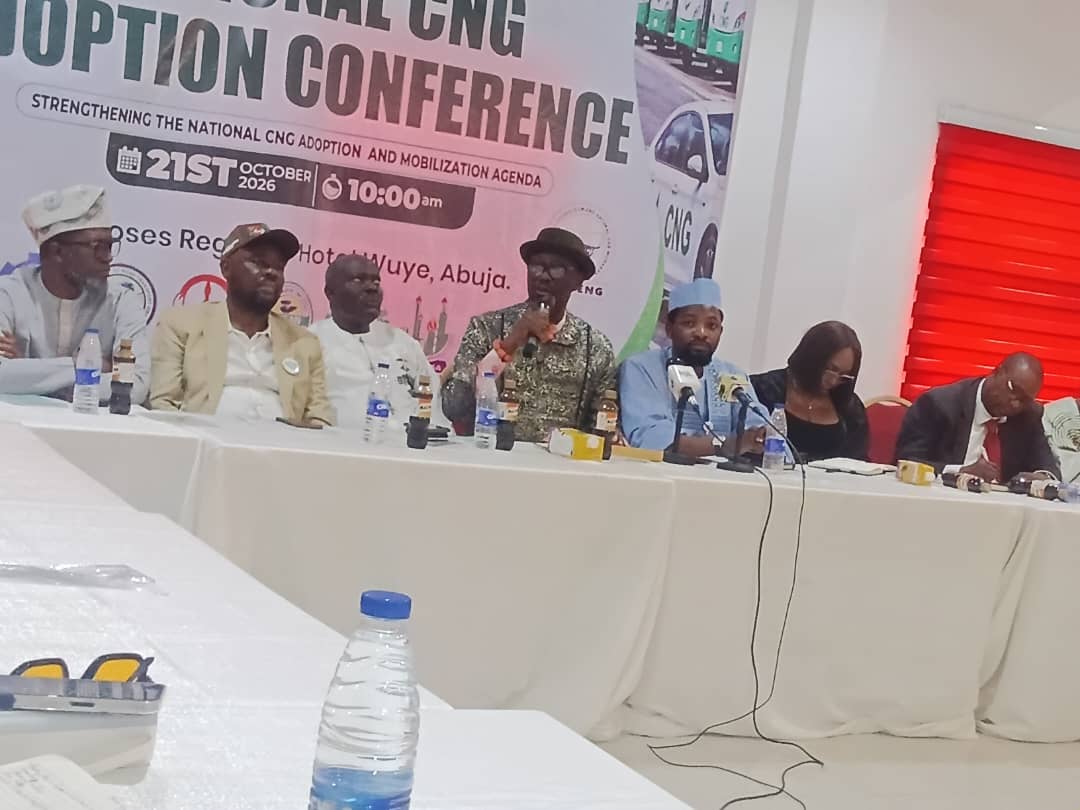
National Chairman of the NCNG-F, Faruk Abdullahi, stated this on Wednesday at the National CNG Adoption Conference and Strategic Stakeholders’ Meeting held at Roses Regency Hotel, Wuye, Abuja.
Abdullahi said Nigeria must now move “from awareness to adoption” and “from policy to implementation,” stressing that the success of the CNG initiative would ultimately be determined by the number of vehicles converted, infrastructure deployed and actual savings delivered to Nigerians.
He identified high vehicle conversion costs, inadequate refuelling stations, limited access to finance, safety concerns and unreliable service delivery as some of the major barriers slowing wider adoption of CNG.
According to him, Nigeria’s abundant gas resources alone will not guarantee widespread use of CNG unless motorists and businesses can see a compelling economic case for switching from conventional fuels.
“The availability of natural gas resources does not automatically translate into widespread adoption,” Abdullahi said, noting that vehicle owners would make the switch only when CNG becomes accessible, affordable, safe, reliable and economically beneficial.
He said the adjustment following fuel subsidy removal should be accompanied by practical alternatives capable of reducing the burden of changing energy costs on households, workers and businesses.
Abdullahi therefore challenged transport unions and associations to move beyond declarations of support by identifying vehicles suitable for conversion, educating their members, linking operators with credible conversion centres and negotiating group conversion arrangements.
He said transport unions were particularly critical because their members operate buses, taxis, trucks and other commercial vehicles used daily by millions of Nigerians.
The Forum also urged financial institutions and investors to develop affordable funding models that would reduce the upfront cost of conversion and allow individual motorists, cooperatives, unions, fleet owners and businesses to participate.
According to Abdullahi, the CNG transition provides investment opportunities across gas supply, refuelling infrastructure, conversion facilities, fleet management, equipment and technology services.
He called on petroleum marketers, gas suppliers and conversion centres to strengthen public confidence through transparent pricing, quality installations, compliance with safety standards and reliable services.
Government institutions and development partners, he added, should concentrate on strengthening enabling policies, expanding infrastructure, enforcing standards and improving access to financing.
Unions Get Adoption Targets
In what could introduce greater accountability into the CNG programme, Abdullahi proposed that participating unions and organisations establish internal structures for driving conversion among their members.
He said each organisation should designate a CNG adoption focal person, develop awareness programmes, identify potential beneficiaries and establish realistic pathways towards conversion.
Where possible, he said, organisations should set indicative adoption targets, begin with pilot fleets and periodically report progress through an agreed coordination mechanism.
“Our most important task is to turn stakeholder support into actual CNG adoption,” he said.
He stressed that potential users must be given clear information on conversion costs, expected fuel savings, vehicle suitability, availability of refuelling infrastructure and maintenance requirements before committing their vehicles.
Abdullahi said pilot programmes could provide real-world evidence of the economics of CNG and help operators assess whether conversion makes financial sense under their individual operating conditions.
Road Show, National Summit Ahead
The NCNG-F chairman also disclosed plans for a National CNG Road Show designed to demonstrate stakeholder support for the initiative and deepen public engagement.
He urged labour organisations, transport unions, petroleum and energy associations and private-sector groups to mobilise their members for the programme rather than leaving implementation solely to government and CNG industry operators.
Abdullahi said momentum generated from the stakeholders’ meeting and road show would feed into the Maiden National CNG Summit scheduled for October 29, 2026.
The summit, he said, would provide a broader platform for discussions on investment, infrastructure, policy coordination and practical measures for expanding CNG adoption across Nigeria.
He maintained that the transition cannot be delivered by government, conversion centres, gas suppliers or infrastructure providers acting independently.
According to him, Nigeria needs coordinated action involving government, organised labour, transport unions, petroleum and energy associations, financiers, investors and other private-sector players.
Abdullahi said the real test of the initiative would not be the number of conferences held or statements issued but its impact on transportation costs and economic activity.
“Ultimately, the success of this initiative will not be measured by the number of meetings we hold, the statements we issue or the number of organisations represented in a room,” he said.
“It will be measured by the number of vehicles converted safely, the number of operators who experience genuine economic benefits, the infrastructure made available, the investments mobilised and the extent to which CNG becomes a practical option for Nigerians.”
He said achieving those outcomes could strengthen Nigeria’s domestic gas market while lowering operating costs, improving business competitiveness, creating jobs and stimulating investment throughout the gas value chain.
I can also recast it with a stronger subsidy-removal/transport-fare angle, making the pressure on commuters and commercial drivers the lead.