





NFIU seeks collaboration with stakeholders to combat illicit financial flows in solid minerals sector

NFIU seeks collaboration with stakeholders to combat illicit financial flows in solid minerals sector

By Onu Okorie
The Chief Operating Officer, Law Enforcement, Support and Coordination sector, Nigerian Financial Intelligence Unit NFIU Mrs Biola Shotunde has assured that the Agency remains fully committed to working closely with partners to combat illicit financial flows in the solid minerals sector.
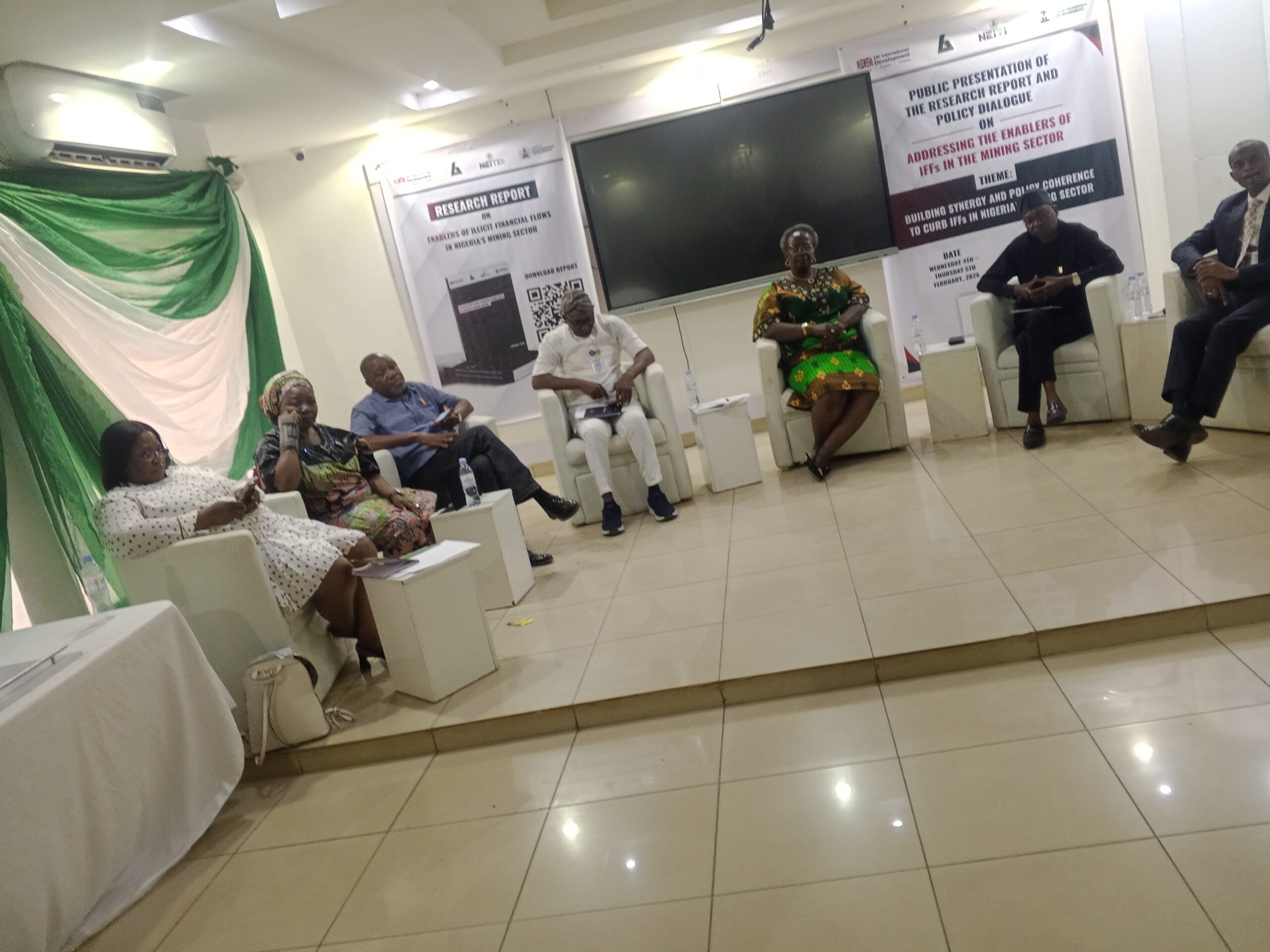
Mrs Biola who spoke on behalf of the Chief Executive Officer of the NFIU yesterday at the public presentation of the research report and policy dialogue on addressing the Enablers of IFFs in Mining sector said that it came at a very critical moment.
According to her, “It calls for targeted policy reforms, strengthened inter-agency collaboration, capacity building, timely intelligence sharing, improved data systems, and the systematic deployment of parallel financial investigations alongside traditional enforcement actions.”
“There is also a clear need to deepen understanding of predicate offences linked to the sector, including corruption, tax evasion, terrorist financing, environmental crimes such as illegal mining, and arms trafficking.”
“This informed the establishment of the Extractive and Environmental Crimes Section within the NFIU, charged to generate both proactive and reactive financial intelligence, support parallel financial investigations, and provide operational assistance and technical support to law enforcement agencies.”
She said that the illicit financial flows has continued to undermine revenue mobilisation, governance, and development outcomes, particularly in resource-rich economies such as Nigeria.
According to her, “in the solid minerals sector, these risks are amplified by structural and operational vulnerabilities that expose the sector to abuse by criminal actors and facilitate the laundering of illicit proceeds.
“Against this background, today’s dialogue is both strategic and necessary. As the central and coordinating agency for AML/CFT/CPF in Nigeria, the NFIU emphasises the importance of embedding Anti-Money Laundering, Counter-Terrorist Financing, and Counter-Proliferation Financing measures across the entire solid minerals value chain.”
“From licensing and production to trading, exports, and payments, AML/CFT/CPF controls must be fully integrated to enable the early identification, tracking, and disruption of illicit financial flows.”
She noted that the NFIU strongly aligns with the emphasis on inter-agency cooperation and public-private partnerships. “No single institution can address illicit financial flows in isolation. Sustainable progress depends on coordinated action across regulators, law enforcement agencies, revenue authorities, sector ministries, financial institutions, Designated Non-Financial Institutions, host communities, and civil society.” Mrs Shotunde said.
She further pointed out that Nigeria’s recent exit from the FATF Grey List and the subsequent delisting from the European Union’s list of high-risk third countries clearly demonstrate what coordinated national action can achieve.
The NFIU boss assured that as the preparations begin for the next AML/CFT/CPF Mutual Evaluation, sustaining these gains is imperative.
“In light of emerging risks in the solid minerals sector, this area will attract increased scrutiny, and Nigeria must demonstrate consistent, measurable, and effective mitigation efforts.It is in this context that the publication being unveiled today is both highly commendable and timely.”
“The research should offer valuable insights to guide prioritisation, inform resource allocation, and support the design and implementation of targeted mitigation measures while strengthening the analytical foundation for policy action, inter-agency coordination, and sector-specific interventions aimed at disrupting illicit financial flows.”











