


AI disruption: Aig-Imoukhuede urges advertising industry to build global competitiveness

By Onu Okorie
The Access Holdings chairman says traditional sources of competitive advantage are losing value as artificial intelligence reshapes the advertising industry.
Chairman of Access Holdings Plc, Aigboje Aig-Imoukhuede, has challenged Nigerian business leaders to rethink their strategies, invest in knowledge and anticipate technological disruption, warning that artificial intelligence (AI) is rapidly changing how businesses create and capture economic value.
He said the advertising industry, in particular, must prepare for a fundamental shift in its business models as emerging technologies increasingly make traditional services easier, faster and cheaper to deliver.
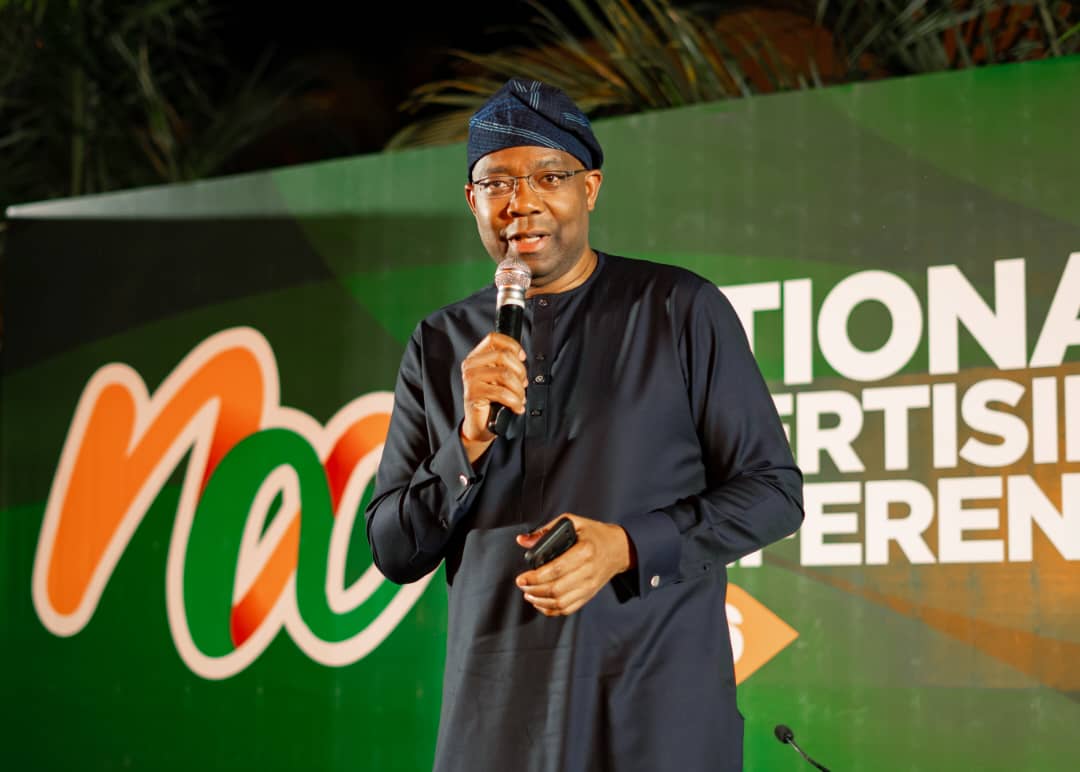
Aig-Imoukhuede gave the warning while delivering the keynote address at the 2026 National Advertising Conference (NAC) in Abuja, where he urged practitioners to move beyond reacting to technological changes and develop the capacity to identify opportunities before they become obvious to competitors.
According to him, the next phase of global competition will be determined less by geographical boundaries and more by the ability of businesses and professionals to understand, adapt to and exploit technological developments.
He maintained that artificial intelligence was not necessarily going to destroy the advertising industry but would redistribute economic opportunities, potentially weakening established players that fail to reinvent themselves.
“I do not think the entire advertising industry is about to be destroyed. What is about to change is who creates value, who captures value and who gets left behind,” he said.
Aig-Imoukhuede explained that while the internet revolution transformed how advertising was distributed and consumed, artificial intelligence was going further by challenging the economics of the services agencies traditionally provide.
He observed that activities which previously required substantial financial resources, large teams and specialised infrastructure could increasingly be undertaken by smaller organisations using advanced technology.
Illustrating the scale of the emerging disruption, he said it was becoming possible to establish a business covering significant aspects of the advertising value chain within a few months and with only a handful of personnel.
The development, he noted, would require advertising agencies to reconsider their competitive advantages, service offerings and revenue models rather than rely on established practices.
However, he identified new opportunities in the changing landscape, particularly the growing importance of personal branding and the ability of individuals to market their skills and capabilities.
He suggested that as competition intensifies in the global economy, the capacity to advertise oneself could become an essential professional skill, just as driving had become an important everyday capability.
Beyond technological adaptation, the Access Holdings chairman identified strategic foresight as a critical factor in determining which businesses would survive and prosper.
Drawing from his banking experience, he recalled a conversation with a branding consultant in London’s Covent Garden around 1994, when he was working at Guaranty Trust Bank.
The consultant had predicted that branding would become a major competitive differentiator for African financial institutions.
Aig-Imoukhuede said the observation helped him recognise an emerging opportunity to build a financial institution with a continental identity.
He identified the period between 1999 and 2007 as a crucial window for pursuing that ambition, an understanding that contributed to the decision by him and his partners to pursue the acquisition of a bank.
The experience, he said, demonstrated the importance of recognising emerging trends early and taking decisive action before competitors fully understand their implications.
During a fireside conversation moderated by Udeme Ufot, Group Chairman of SO&U, he challenged advertising practitioners to apply the same strategic thinking they deploy for clients to their own businesses.
He argued that professionals who advise organisations on anticipating market changes must first demonstrate the ability to anticipate changes within their own industry.
“Your sector is meant to help clients anticipate what the market will want. To do that for them, you must first do it for yourselves,” he said.
He also urged industry leaders not to allow uncertainty surrounding technological changes to discourage innovation and investment in new capabilities.
According to him, knowledge and preparation remain essential tools for navigating unfamiliar business environments, adding that apprehension about new developments should encourage learning rather than resistance.
“Let nervousness motivate and catalyse you to overcome the natural tendency to move into fear. When you see me take these steps, there is nervousness. Knowledge helps me move beyond it,” he said.
The Access Holdings chairman further warned that African businesses could not rely on local market familiarity or existing professional achievements to remain competitive in an increasingly interconnected global economy.
He said Nigerian professionals must develop the discipline, expertise and work ethic required to compete with their counterparts in Asia, Europe and North America.
Using football superstars Cristiano Ronaldo and Lionel Messi as examples of sustained excellence, he argued that global competitiveness requires continuous improvement, commitment and an uncompromising determination to succeed.
“Ask whether you are hungry enough to beat the person in Asia, North America or Europe. If you are not, you will not develop the discipline they have, and they will beat you,” he said.
He stressed that the challenge confronting the advertising industry extended beyond adopting artificial intelligence tools to fundamentally rethinking the value it offers clients and the wider economy.
His message to practitioners was that technological disruption should be treated as an opportunity to develop new markets, business models and professional capabilities rather than simply defend traditional sources of revenue.
The 2026 National Advertising Conference brought together industry stakeholders to examine emerging developments shaping the advertising business and the future of the profession.
Aig-Imoukhuede’s intervention placed particular emphasis on the need for Nigerian businesses to move from responding to disruption after it occurs to anticipating change, preparing for it and positioning themselves to capture the opportunities it creates.