

Why Customs embarked on modernisation of operation – DC Maiwada

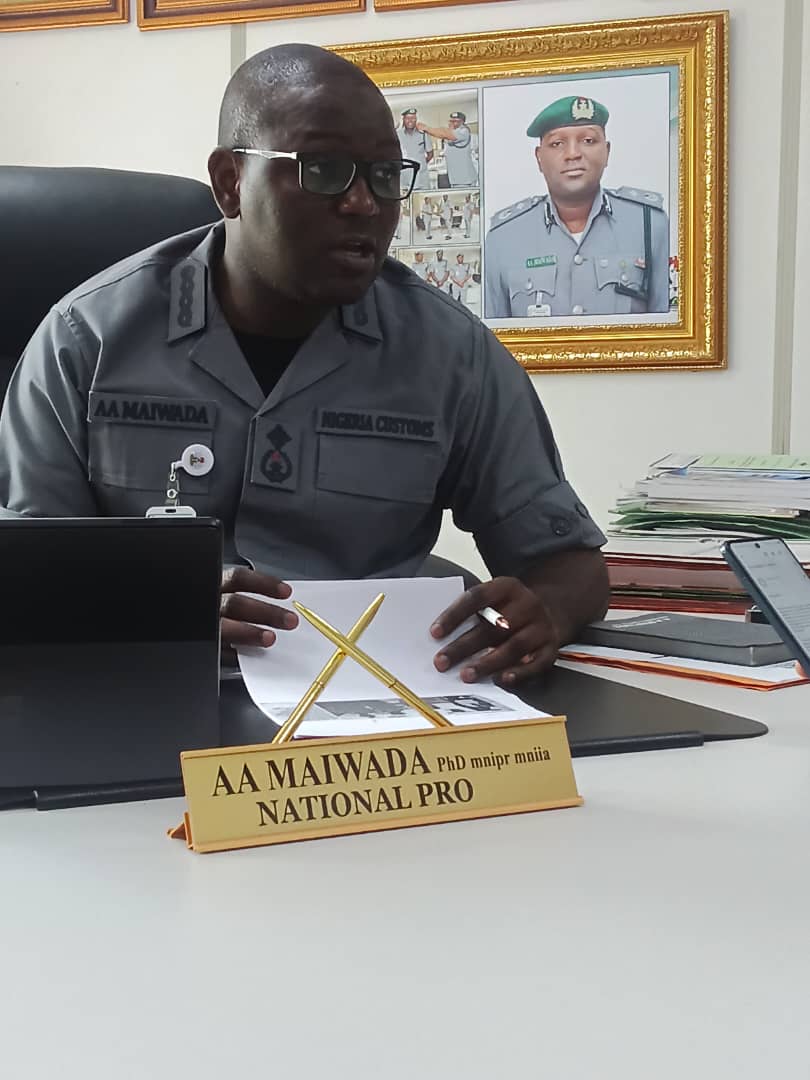
Since assuming office as the National Public Relations Officer of the Nigeria Customs Service (NCS) in April 2023, Abdullahi Aliyu Maiwada has emerged as one of the prominent voices shaping public understanding of the Service’s operations, reforms and expanding role in Nigeria’s economic security.
As the official bridge between the Customs Service and the Nigerian public, Maiwada carries a responsibility that goes beyond issuing statements. At a time when the NCS embark on strategic reforms, intensifying campaign against smuggling, revenue leakages and other forms of economic sabotage, effective communication has become an important component of the Service’s enforcement and reform agenda.
With a deliberate and increasingly proactive communication strategy, Maiwada has sought to keep Nigerians abreast of developments within the Service, from major seizures and anti-smuggling operations to trade facilitation, revenue mobilisation, border management and institutional reforms.
Through regular engagement with the media, he has helped explain not only what the Service is doing, but also why its interventions matter to Nigerians.
In this interview with the editorial team of Presidentstrides International Magazine/Daily Online Newspaper, led by Editor Onu Okorie, Maiwada speaks on the achievements of the Adeniyi-led Customs administration, the battle against smuggling and economic sabotage, revenue generation, trade facilitation and the ongoing transformation of the Nigeria Customs Service.

Ouestion:
Since the present team came on board after the appointment of Comptroller-General Mr Adewale Adeniyi in June 2023, you have pursued reforms aimed at modernising the Nigeria Customs Service. Looking back, what would you consider the three most significant reforms that has been introduced, and what measurable changes have they brought to the Service?
Answer:
Okay, thank you very much for this opportunity. First, the Controller General of Customs was appointed in 2023 by President Bola Ahmed Tinubu. But the CGC—before becoming the CGC has served under different administrations as management member, as a spokesperson of the Service. So he came up with the idea that he understood how the running of the Service has been done, with three policy thrusts. First is innovation, second is to collaborate, because a tree cannot make a forest, and third, to consolidate on previous gains.
Now, because you talk of measurable impact, I will look at the measurable impacts in the area of our core responsibilities. In the area of revenue collection, from 2023 to today, we are having a kind of upward achievement in the revenue we have collected on behalf of the Federal Government of Nigeria.
What we collected in 2023 was lower than what we collected in 2024, implying the 2024 surpassed that of 2023, and we further improved in 2025. And in 2026, we have an ambitious target of about 11 trillion, and so far as at the last quarter of our operation in 2026, we have collected over seven trillion Naira.
Since we have collected over seven trillion, we’re hoping that before the end of this year, we are going to achieve the target set to us by the Federal Government, the way we have achieved and surpassed that of 2023-2024 and 2025. That’s in the area of revenue generation.
In terms of trade facilitation, we have, for the first time, the Nigeria Customs Service have partaked in rigorous time release studies in order to ascertain where we are having some bottlenecks in clearance of goods. We have embarked on so many trade facilitation tools.
In addition to time release studies, we have rolled out advanced ruling, which is a legally binding decision on classification, valuation, or rules of origin prior to importation of goods. We have also embarked on Authorized Economic Operator Programme AEO.
We started with the piloting after fulfilling so many rigorous procedures set up by World Customs Organization in collaboration with so many agencies that help us to roll out the AEO. Today, we have over 100 AEO releases into our AEO program, which is a kind of authorized accounting operator program.
It’s a kind of a compliance-based release process in which goods are fast-tracked and the movement of goods are facilitated for compliant traders without customs intervention due to understanding what they have done. That is trade facilitation.
In terms of anti-smuggling activities and border security, we have worked a lot. Number one, we have the Controller General Constitution Operation 1 Wing, which is a special operation that deals with managing the smuggling of petroleum products outside his country.
That has been a menace, and with that, the team since inception have worked—it’s an intelligence-driven operation that led to the interception of thousands, millions of liters of petroleum product intended to be smuggled outside this country. In terms of arms and ammunition, we have recorded siezures. We have recorded major siezures in Port Harcout of arms and ammunition. We have also recorded major siezures of arms and ammunition in Tincan Island for this year, that is 2026, twice.
And also recorded a siesure of different types exotic drugs that are abused, it could be hard drugs, narcotic drugs and others. A lot of them have been seized both at our seaport, land borders, and airports. One of the critical roles Nigeria Customs Service have played in this administration so far that every Nigerian will feel the impact is to work in collaboration with other agencies to make sure that we curtail illicit financial flow.
That led to siezures of thousands of currencies, in thousands, in millions, that were not declared prior to importation or exportation. And we have worked in line with the Nigerian Financial Intelligence Unit and other agencies to make sure that we fulfill our rights, and that is why today Nigeria successfully exited the Financial Action Task Force FATF”grey list”
When you travel abroad, you can bring out your ATM and you can use your Naira ATM abroad outside this country, courtesy of what we have done in collaboration with other agencies. So those are factors.
If you see, I have talked about three core responsibilities, and at the same time, I talked about what we have done in relation to three policy thrusts of the Controller General of Customs. However, for the modernization project of Nigeria Customs Service, if you remember, the CGC made a 20-year concession agreement, for customs modernization project.
In his mantra of consolidation, we have successfully rolled out a clearance platform that was indigenously produced by Nigerians to Nigerians and to solve indigenous problems. That is called B’ Odogwu unified customs management system. Earlier, we used to get source codes or whatever, from countries of third parties that are not indigenous but today we have produced a software and we are using that software. We have embarked on non-industry inspection technology.
Scanners are coming in batches. As I’m talking to you, a team are in China for factory acceptance tests of some of the scanners that will be coming into Nigeria very soon, in addition to what we have already in major seaports.
What are we doing? We have married declaration with image analysis today so that you will be able to understand those items that are brought in without bringing in items that either defy the payment of appropriate customs duties or are inimical to our national security.
So when it comes to modernization, we are doing very well. Officers’ welfare is also prioritized by the Controller General of Customs.
We have embarked on a kind of a scientific study to hear from our stakeholders, to hear from customs officers, to see how we can improve integrity within the rank and files of customs officers as well as stakeholders. That is why we had a customs integrity perception survey, which led to another perception survey last year in 2025.
And now we are also topping up with another survey. The outcome of the survey and research will give us a kind of idea of how to improve in our services.
Queston:
In April 2026, the Service announced a reform agenda developed in collaboration with the Presidential Enabling Business Environment Council, PEBEC focusing on joint inspections, risk-based cargo clearance, scanning infrastructure, service timelines and inter-agency coordination. What practical changes should importers, exporters and clearing agents expect from this initiative?
Answer:
So when you talk of practical changes, you are talking of PEBEC, and I will tell you that last year our ranking was very high—we did very well. We came at the top of the ranking of PEBEC for the ease of doing business.
This time around, we are collaborating with PEBEC. If you carefully look at our website, www.customs.gov, you will see report.gov
It is a digital platform that we use, which is monitored by PEBEC to make sure that all transactions, all issues are resolved within 24 hours, and if they could not be resolved, the reasons for inability to resolve those issues will be stated clearly. So we are working hard with PEBEC to make sure that we make ease of doing business something very fundamental. It’s cardinal to our responsibility. We want to facilitate legitimate trade, and PEBEC are doing everything possible to work together, to monitor what we are doing, and also to advise on how to do things better.
Question
One of the most significant developments in Customs present team has been leadership role within the World Customs Organization (WCO). Nigeria’s standing in international customs administration has become an important part of the discussion about the Service’s transformation. What does this achievement mean for Nigeria, and how does it reflect the country’s standing among the world’s customs administrations?
Answer
Well, for the first time in the history, a Nigerian, in person of the Controller General of Customs, Mr. Adewale Adeniyi MFR, was elected as the, World Council chairperson of the WCO council, and he had demonstrated the capacity to lead that very exalted position. That’s why he was later re-elected this year for the second tenure after doing a very good job in the first tenure. First, if you understand, Nigeria flagged its flag at Brussels, Belgium the headquarters of the WCO as Adeniyi made history as the first Nigerian to head the 73-year-old organisation, which has 186 member countries and is the highest decision-making body in global customs administration. So there many advantages that come with this kind of responsibilities.
Today, we have customs officers that are experts in different fields within the WCO, and some might get a retainer-ship position in the WCO.
So the role of Nigeria Customs Service in Africa and in the world is becoming so exalted. In terms of our customs-to-customs cooperation, you can see a lot of improvement.
We have signed so many customs mutual administrative agreements with many countries. The General Administration of China Customs, the UK, His Majesty’s UK Revenue and Customs Authority, and so many administrations that we have signed.
The Saudi Arabian Customs, we also signed a kind of a CMMA with them, and so many customs administrations. So because of what we are doing it has expanded our role.
As I’m talking to you, our officers are in Brazil for a study tour. The directors staff at our Nigeria Customs Command staff college are currently in Brazil for a study tour to learn best practice from them.
We were also for a leadership training at Casablanca. We also visited their training college in Casablanca in Morocco, all these are part of what we derive from this kind of partnership. And today, customs is not only about Nigeria activities, but Nigeria Customs Service is felt all over the world.
Question:
Okay. Does this position within the WCO translate to any practical benefit to Nigerian traders, manufacturers, exporters, and wider economy?
Answer:
If customs will have their capacity-building initiatives, their trainings initiatives, their collaborative initiatives, the primary reasons for those upscaling of the capacity of officers is for them to effectively discharge the services that are bestowed upon them. So if they can discharge those services, then definitely it will have a triple effect on what the trading members of the public will feel. Because when they are more efficient, more knowledgeable and more co-ordinated customs, definitely trade will be facilitated, and people will have a kind of a better experience in what we do in Nigeria Customs Service.
Question:
How much revenue does the service estimate that Nigeria lose annually through under-declaration, improper classification and or smuggling, and under-valuation and other forms of customs?
Anawer:
Well, thank you for that. That’s a very good question, but it will be difficult for me to state it here. If we know how much we lose, then we will not allow it to go down the drain.
So it will be difficult for me to give you a scientific data that defines how much we lose. But obviously, we are not saying we have a perfect system.
Yes, there might be one or two loopholes, but the question is; do we perform optimally? We can see, yes but there is room for improvement.
Yes, there is room for improvement. So we are not a custom that says we are perfect. Yes, there are revenue leakages, but every day, day in, day out, we are looking for better ways, better approach to improve in our services that will lead to, first, suppression of smuggling to the bare minimum, as well as reducing all avenues for revenue leakages.
Question
Nigeria continues to face challenges involving port congestion, cargo delays, smuggling and the cost of doing business. How do you reconcile these challenges with the country’s growing international profile in customs administration?
Answer:
Well, we have our share of challenges, but what I would say about delays or issues relating to clearance within the port, it is—discussion continues. It is an issue that is getting a kind of a whole-of-government approach.
It is not really about custom when it comes to clearance value chain. We need to have ports that are effective. We need to have authorities that are responsible for our ports, and that is why the government have embarked on modernization of some of our ports and for it to be efficient and effective. So what I would say generally is I believe, yes, there are challenges, but you ask, where did we come from, and where are we today, and where are we heading to? We will be there. where we are heading to is a better experience than where we left earlier.
Question:
Okay. What message do you have?
My message, finally, to Nigerians is for us to be compliant, for us to ensure that we—Nigerians should make sure that they avoid illicit trade and embrace compliance, pay the right duty, avoid illicit trade, and make sure that we are patriotic, and Nigeria should be first before any other country.