

Counting gains of Bangkok: Oyedele takes Nigeria’s investment agenda to the world

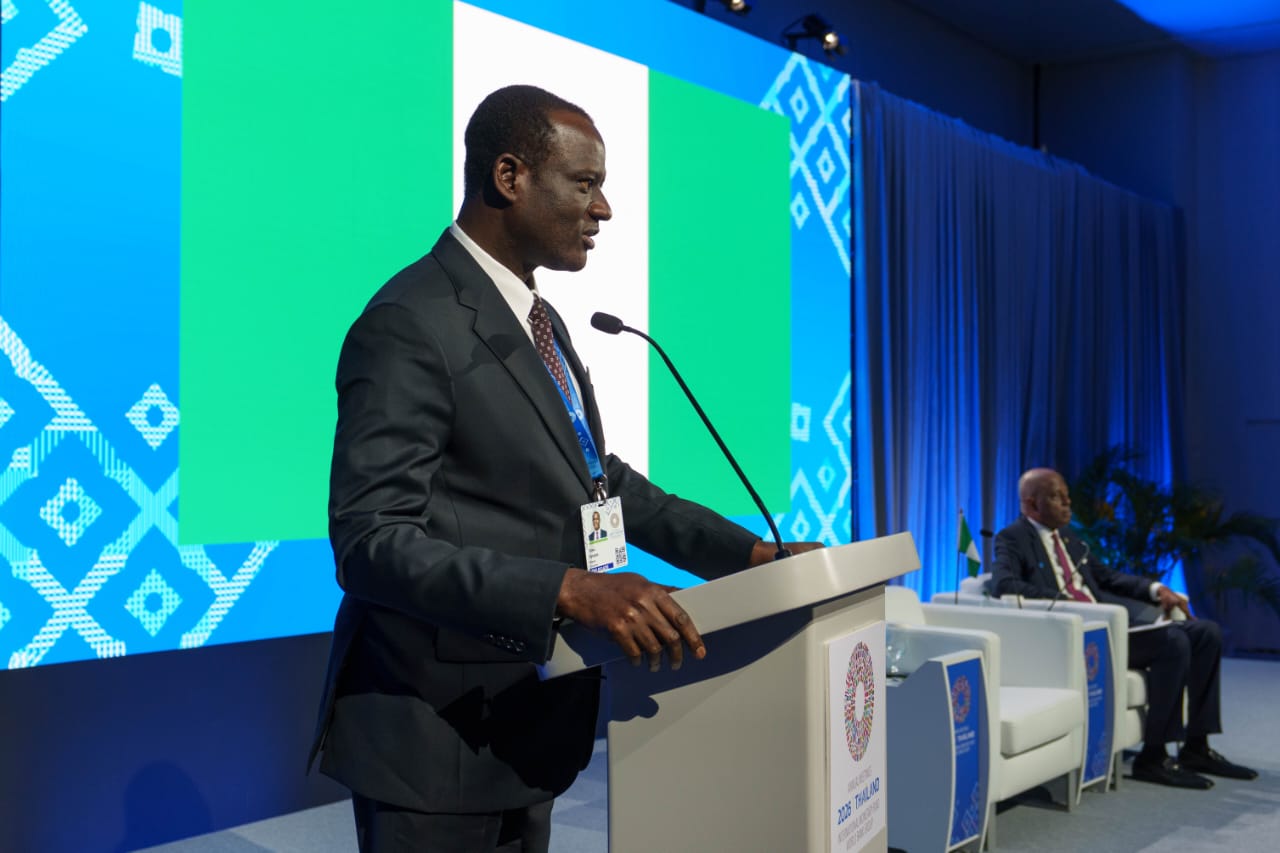
From a $78.5bn investment pipeline to a push for cheaper financing for Africa, Nigeria emerged from the just-concluded IMF/World Bank meetings with ambitious commitments writes ONU OKORIE

Nigeria went to Bangkok with an economic reform story. It returned with something potentially more important — an investment proposition and a stronger platform from which to argue Africa’s case before the global financial establishment.
For one week at the just-concluded 2026 Annual Meetings of the International Monetary Fund and World Bank Group in Thailand, Minister of Finance and Coordinating Minister of the Economy, Taiwo Oyedele, operated on several fronts.
He was Nigeria’s chief economic salesman, presenting 65 projects requiring about $78.5 billion in capital to international investors.
He was also chairman of the G-24, putting Nigeria at the head of developing countries demanding cheaper financing, fairer representation in the Bretton Woods institutions and improvements to a global debt architecture that has become increasingly burdensome for poorer economies.
Then came his bilateral engagements with World Bank President Ajay Banga and African Development Bank President Sidi Ould Tah, where discussions moved from broad declarations to guarantees, infrastructure financing, project implementation and the cost of capital.
Across these engagements ran another message: macroeconomic stability is not an end in itself.
For Oyedele, Nigeria’s next economic test is whether reforms can produce businesses, investment and employment.
“Stability was the first test. Growth that employs our people is the second,” he declared as the meetings wound down.
That sentence perhaps provides the most useful yardstick for assessing what Nigeria actually gained from Bangkok.
The meetings generated promises, investor interest and international visibility. The real test begins after Bangkok: how much of the $78.5 billion pipeline will reach financial close? How much new capital will enter Nigeria? How quickly will development-finance commitments translate into power plants, roads, factories and other infrastructure? And, ultimately, how many jobs will they create?
$78.5bn: From reform story to investment proposition
Perhaps the most consequential Nigerian initiative unveiled in Bangkok was Projects Nigeria.
Instead of simply asking foreign investors to “invest in Nigeria,” the government went before the international investment community with 65 identified projects carrying an estimated capital requirement of $78.5 billion.
The projects cut across major areas of the economy, including energy, manufacturing, mining, transportation, agriculture, technology, healthcare and urban development.
It represented a significant change in emphasis.
For much of the past three years, international discussion about Nigeria has centred on painful economic adjustments — removal of the petrol subsidy, foreign exchange reforms, inflation, currency depreciation and fiscal restructuring.
Bangkok offered the government an opportunity to change the conversation from adjustment to opportunity.
Nigeria’s pitch was essentially that some of the painful corrections have been made and that investors should begin positioning themselves for the growth phase.
The government took to Bangkok figures it believes strengthen that argument: real GDP growth of about 4.4 per cent in the second quarter of 2026, four consecutive months of easing inflation, foreign reserves above $55 billion, a tax-to-GDP ratio of 12.5 per cent and public debt equivalent to about 36 per cent of GDP.
More important than those numbers, however, is what happens next.
An investment pipeline is not the same thing as investment.
Expressions of interest from Asian and European investors are encouraging, but the real economic value comes only when interest becomes commitments, commitments become financing and financing becomes physical projects.
That is why the $78.5 billion figure simultaneously represents Bangkok’s biggest opportunity and its biggest test.
Nigeria does not need another catalogue of prospective projects gathering dust in government offices. Projects Nigeria must become a transaction pipeline with identifiable timelines, financing structures, regulatory approvals and financial-close dates.
If that happens, Bangkok could prove to be an important turning point in Nigeria’s attempt to shift from public-sector-led development towards private-capital-driven infrastructure and production.
World Bank guarantees: Making Nigeria investible
Oyedele’s meeting with World Bank Group President Ajay Banga provided another important piece of the financing strategy.
The meeting focused particularly on making greater use of World Bank guarantee instruments.
That matters.
One of Nigeria’s biggest investment challenges is not necessarily the absence of global capital. Trillions of dollars are controlled by pension funds, insurance companies, sovereign wealth funds, infrastructure funds and other institutional investors around the world.
The difficulty is convincing that capital to accept Nigerian risk at affordable prices.
Guarantees can change that calculation.
By absorbing or mitigating specified political, regulatory, payment or project risks, multilateral guarantees can make projects that investors previously regarded as too risky more bankable.
For Nigeria, therefore, the World Bank relationship could increasingly move beyond traditional sovereign borrowing towards using the institution’s balance sheet to mobilise multiples of private capital.
Power infrastructure was identified as a priority in the discussions — appropriately so.
Nigeria cannot realistically aspire to seven per cent growth, industrial expansion or large-scale job creation while businesses continue to bear the enormous cost of unreliable electricity.
Human capital was another priority.
The implication is that Nigeria’s next development phase requires simultaneous investment in physical infrastructure and people.
Bangkok therefore presented an opportunity to connect Nigeria’s domestic reforms with a global development-finance system increasingly focused on using limited public money to unlock substantially larger pools of private capital.
G-24: Nigeria speaks beyond Nigeria
Oyedele’s most important contribution in Bangkok may ultimately prove to be one that did not concern Nigeria alone.
As chairman of the G-24, he led emerging and developing economies in demanding reforms to the architecture of international finance.
His argument went to the heart of Africa’s development dilemma.
African countries need enormous amounts of capital to build electricity systems, railways, ports, roads, hospitals, schools and digital infrastructure. Yet many of those countries borrow at interest rates far higher than richer economies.
The result is a vicious cycle.
Countries with the greatest infrastructure deficits frequently face the highest cost of financing the infrastructure required to escape poverty.
Oyedele pushed for IMF quota and governance reforms, stronger representation of developing countries at the World Bank, greater access to affordable development finance and faster, more coordinated sovereign debt restructuring.
He also pressed for stronger international action against tax avoidance and illicit financial flows and a greater voice for developing economies in global economic decision-making.
These are not abstract diplomatic arguments.
Every additional percentage point African governments pay on borrowing is money potentially diverted from electricity, education, healthcare and infrastructure into debt servicing.
The demand for a fairer international financial architecture is therefore ultimately a development question.
Nigeria’s leadership of the G-24 gave Africa’s largest economy an opportunity to speak not simply as a borrower seeking concessions but as an advocate for structural reform of the system itself.
That role strengthens Nigeria’s diplomatic relevance at a time when emerging economies are demanding greater influence over institutions established in a very different global economic era.
The AfDB connection: Attacking Africa’s cost of capital
The same argument featured prominently when Oyedele met AfDB President Sidi Ould Tah.
Nigeria and the bank agreed to undertake a joint technical review of the AfDB’s portfolio in the country.
On the surface, a portfolio review sounds bureaucratic.
Its potential economic significance is considerably greater.
Nigeria already has development projects financed by multilateral institutions that encounter procurement delays, counterpart-funding problems, regulatory bottlenecks and implementation difficulties.
Accelerating existing projects can sometimes produce development gains more quickly than announcing entirely new ones.
The proposed review is therefore expected to identify bottlenecks, accelerate implementation and better align AfDB operations with Nigeria’s development priorities.
Oyedele also reaffirmed Nigeria’s intention to remain the bank’s largest shareholder and meet its capital subscription obligations.
But the discussion went beyond Nigeria.
The Finance Minister challenged the high borrowing costs imposed on African countries and raised concerns that international credit ratings do not always sufficiently recognise improvements in reform performance and economic fundamentals.
The AfDB’s response could be significant.
Ould Tah disclosed plans for a facility to provide African governments with technical and analytical assistance in dealing with international credit-rating agencies.
Better data and stronger engagement will not eliminate sovereign risk. But if African governments can demonstrate their economic fundamentals more effectively and challenge questionable assumptions, even modest reductions in risk premiums could produce substantial savings.
The discussions also covered local-currency financing, credit enhancement, trade insurance and greater African financial integration.
Together, these mechanisms address one central problem: how to reduce the cost and risk of financing African development.
From Nigeria’s reform laboratory to an African agenda
Bangkok also allowed Oyedele to present Nigeria’s experience as part of a wider conversation about economic reform in Africa.
His argument at the Africa’s Golden Future Forum was that reforms cannot be judged simply by whether governments undertake them.
Sequencing matters. Communication matters. Institutions matter. Public trust matters.
Nigeria’s experiences with petrol subsidy removal, foreign exchange liberalisation and tax reform illustrate how policy decisions can have profound consequences for household incomes and businesses.
The lesson being exported from Nigeria is therefore not that every African country should copy Abuja’s policies.
Rather, difficult reforms need sequencing, credible institutions and measures that protect vulnerable citizens.
Oyedele linked that domestic agenda to the African Continental Free Trade Area.
Africa cannot achieve meaningful economic transformation if its countries remain fragmented into small markets separated by expensive logistics, inefficient borders and poor infrastructure.
Removing trade barriers, improving electricity supply, investing in storage and processing infrastructure and simplifying border procedures could help turn AfCFTA from a treaty into a genuine continental market.
Nigeria’s National Single Window initiative fits into that larger ambition.
For Nigeria, deeper African integration offers manufacturers and service companies access to a continental market. For Africa, it creates the possibility of building regional value chains rather than continuing the historical model of exporting raw commodities and importing finished products.
Oyedele’s jobs doctrine
Yet perhaps the strongest theme Nigeria carried through Bangkok was jobs.
It also aligned with the central concern of this year’s World Bank meetings.
Over the next 10 to 15 years, about 1.2 billion young people are expected to enter the global labour market, while only around 400 million jobs are projected to become available.
That leaves a potential gap of roughly 800 million opportunities.
For Africa, home to the world’s fastest-growing youth population, the implications are profound.
Oyedele warned that artificial intelligence could make the challenge even more complicated by allowing economies to generate higher output without producing employment on anything approaching the scale required.
His response was to argue that international development institutions should increasingly judge economic success by jobs created.
This is potentially one of the most important shifts in Nigeria’s economic narrative.
For years, governments have celebrated GDP growth, reserve accumulation, revenue increases and improvements in fiscal balances.
All are important.
But an economy can improve on paper while millions of citizens feel little change in their daily lives.
A jobs test changes the question.
It asks whether economic growth is creating factories, farms, technology businesses and service industries capable of employing people.
It asks whether infrastructure financing is lowering the cost of doing business.
It asks whether investment is generating opportunities beyond government and the informal economy.
And it asks whether young Nigerians entering the labour market can reasonably expect productive employment.
If the government adopts that test seriously, then its own performance will increasingly have to be measured not simply by inflation, reserves or revenue but by employment, productivity and household incomes.
Bangkok’s unfinished business
The just-concluded meetings have therefore left Nigeria with an unusual combination of opportunity and obligation.
There is a $78.5 billion investment pipeline to convert into transactions.
There are World Bank guarantee instruments that could help mobilise private capital into infrastructure.
There is an AfDB portfolio review that must accelerate existing projects rather than become another administrative exercise.
There are commitments for deeper cooperation from international partners.
And there is the global financial reform agenda Nigeria championed through the G-24.
But international meetings do not build power plants.
Communiqués do not employ young people.
Investor expressions of interest do not automatically become foreign direct investment.
The danger after every major international economic gathering is that impressive announcements fade once delegations return home.
Avoiding that outcome will require relentless follow-through from the Ministry of Finance and other government agencies.
Every major project pitched in Bangkok should have clear milestones. Investors expressing interest should be tracked. Regulatory obstacles should be removed quickly. Projects capable of benefiting from multilateral guarantees should be identified and moved towards bankability.
The AfDB portfolio review should similarly produce measurable timelines for delayed projects.
In other words, Nigeria now needs a post-Bangkok implementation scoreboard.
The real gains will be counted at home
Oyedele’s performance in Bangkok was significant partly because Nigeria did not restrict itself to asking international institutions for more money.
The country simultaneously presented itself as an investment destination, pushed for changes in global financial governance and sought practical mechanisms to reduce the cost of development finance.
That combination matters.
Nigeria’s economic size means its voice can carry considerable weight in African and developing-country negotiations. Its domestic challenges also mean it has much at stake in securing a financial system that provides emerging economies with affordable capital.
Bangkok allowed the Finance Minister to connect both interests.
For Nigeria, the argument was: reforms have restored a measure of stability; now capital must flow into production, infrastructure and jobs.
For Africa, it was: domestic reform must be complemented by reform of an international financial architecture that too often makes development capital prohibitively expensive.
For the Bretton Woods institutions, Oyedele’s challenge was equally clear: development success cannot ultimately be measured by balance sheets alone when hundreds of millions of young people require employment.
That is why the significance of Bangkok extends beyond the conference halls of Thailand.
If the $78.5 billion project pipeline attracts substantial capital, if World Bank guarantees unlock infrastructure investment, if the AfDB partnership accelerates projects, and if Nigeria’s G-24 leadership helps sustain momentum towards cheaper and fairer financing for developing economies, Bangkok could become an important marker in Nigeria’s transition from economic stabilisation to investment-led growth.
But Nigerians will apply a much simpler test.
They will count factories built, electricity generated, businesses expanded, investments landed and jobs created.
After the speeches, bilateral meetings, investment presentations and global diplomacy, that is the balance sheet that matters most. And it is on that balance sheet that the gains of Bangkok will ultimately be counted.