

FRSC probes Otedola Bridge inferno, moves against reckless petroleum tanker drivers

FRSC probes Otedola Bridge inferno, moves against reckless petroleum tanker drivers

By Onu Okorie
Federal Road Safety Corps FRSC has ordered an immediate investigation into Sunday’s tanker inferno beneath Otedola Bridge on the Lagos-Ibadan Expressway, as preliminary findings blamed excessive speed for the crash involving a diesel-laden truck.
Corps Marshal, Shehu Mohammed, who ordered the probe, warned that reckless driving by operators of heavy-duty vehicles carrying petroleum products had become an unacceptable threat to lives, critical public infrastructure and national safety.
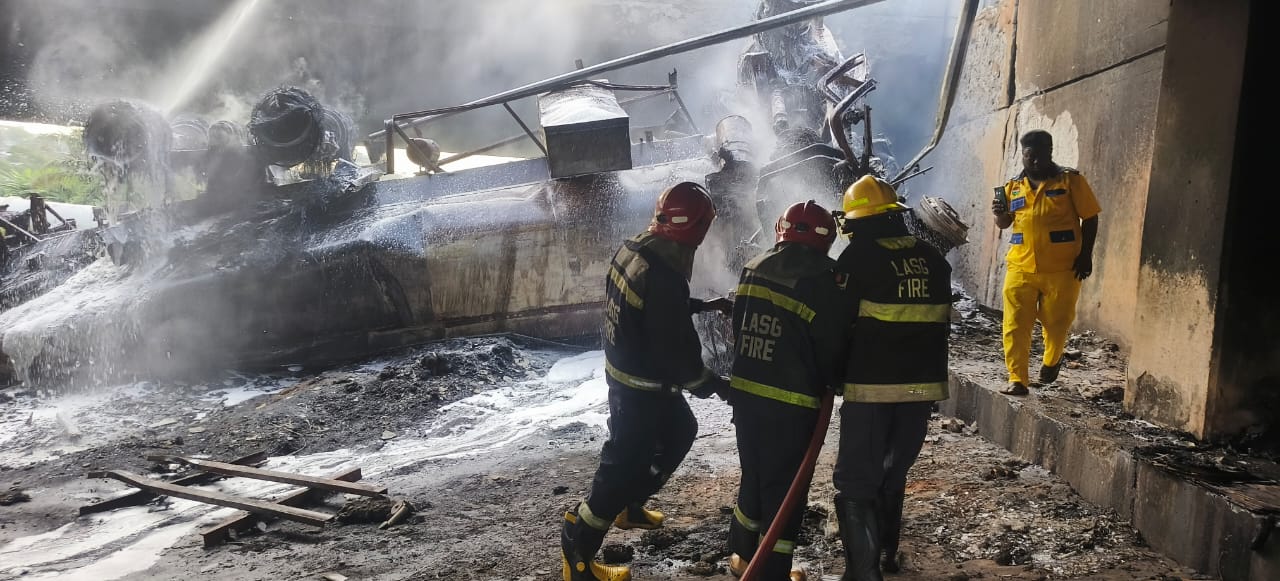
The accident occurred at about 4:10 p.m. on October 19, 2026, when the diesel-laden tanker plunged into the underpass beneath Otedola Bridge on the outward section of the Lagos-Ibadan Expressway and burst into flames.
Two adult male occupants of the vehicle sustained injuries and were taken to the Lagos State Accident and Emergency Centre for treatment. No fatality was recorded in the initial report.
According to a report submitted to the Corps Marshal by the FRSC Lagos Sector Command, preliminary investigation identified excessive speed as the cause of the crash.
The development has again raised concerns over the safety of petroleum-product transportation on some of Nigeria’s busiest highways and the potential consequences of tanker crashes in densely populated areas.
The FRSC said its rescue team received information about the accident at approximately 4:15 p.m. and arrived at the scene at about 4:20 p.m.
Its personnel joined the Lagos State Fire and Rescue Service, Lagos State Traffic Management Authority, the Nigeria Police and other emergency responders to contain the inferno, control traffic and prevent further casualties.
Reacting to the incident, Mohammed described the crash as a grave reminder that irresponsible driving could have consequences far beyond the driver and vehicle, particularly where hazardous products and heavily used public infrastructure were involved.
He directed that the circumstances leading to the crash be thoroughly investigated and appropriate action taken based on the findings.
The Corps Marshal said transporting petroleum products required a higher level of professional competence, discipline and compliance with safety standards because of the potentially devastating consequences of an accident.
He warned tanker drivers that the size and weight of their vehicles, combined with the hazardous nature of their cargo, left little room for mistakes on the road.
According to him, excessive speed, dangerous manoeuvres, inadequate vehicle maintenance and failure to comply with prescribed safety requirements could quickly turn a routine journey into a major disaster.
FRSC warns tanker owners
Mohammed also put petroleum tanker owners and fleet operators on notice, warning them against sacrificing public safety for commercial considerations.
He said unrealistic delivery schedules, inadequate supervision of drivers and poor maintenance practices must not be allowed to expose Nigerians to avoidable accidents.
The FRSC consequently called for stronger professional training for tanker drivers, closer monitoring of driving behaviour, regular inspection and maintenance of trucks and strict enforcement of speed limits and other road safety requirements.
Mohammed commended emergency agencies for their coordinated response to the Otedola Bridge incident but warned motorists and residents against crowding accident scenes.
He particularly cautioned Nigerians against approaching burning or crashed petroleum tankers to scoop spilled products or record photographs and videos, saying such actions could result in fatalities if an explosion or secondary fire occurred.
Motorists were also urged to comply with traffic-control instructions and avoid obstructing firefighters, rescue personnel and other emergency workers.
The Corps Marshal said the FRSC would intensify public education, operational surveillance and enforcement against dangerous driving.
“For the FRSC, the imperative is clear: prevent what can be prevented, investigate what has happened and hold negligence accountable wherever established,” the Corps said.
Mohammed maintained that road safety was not merely a regulatory requirement but a national responsibility shared by drivers, transport companies and other road users. He warned that individual decisions behind the wheel must not be allowed to become a source of tragedy for innocent Nigerians.