






Umahi unveils sweeping road agenda across Nigeria,

….coastal highway renamed for Tinubu
By Onu Okorie
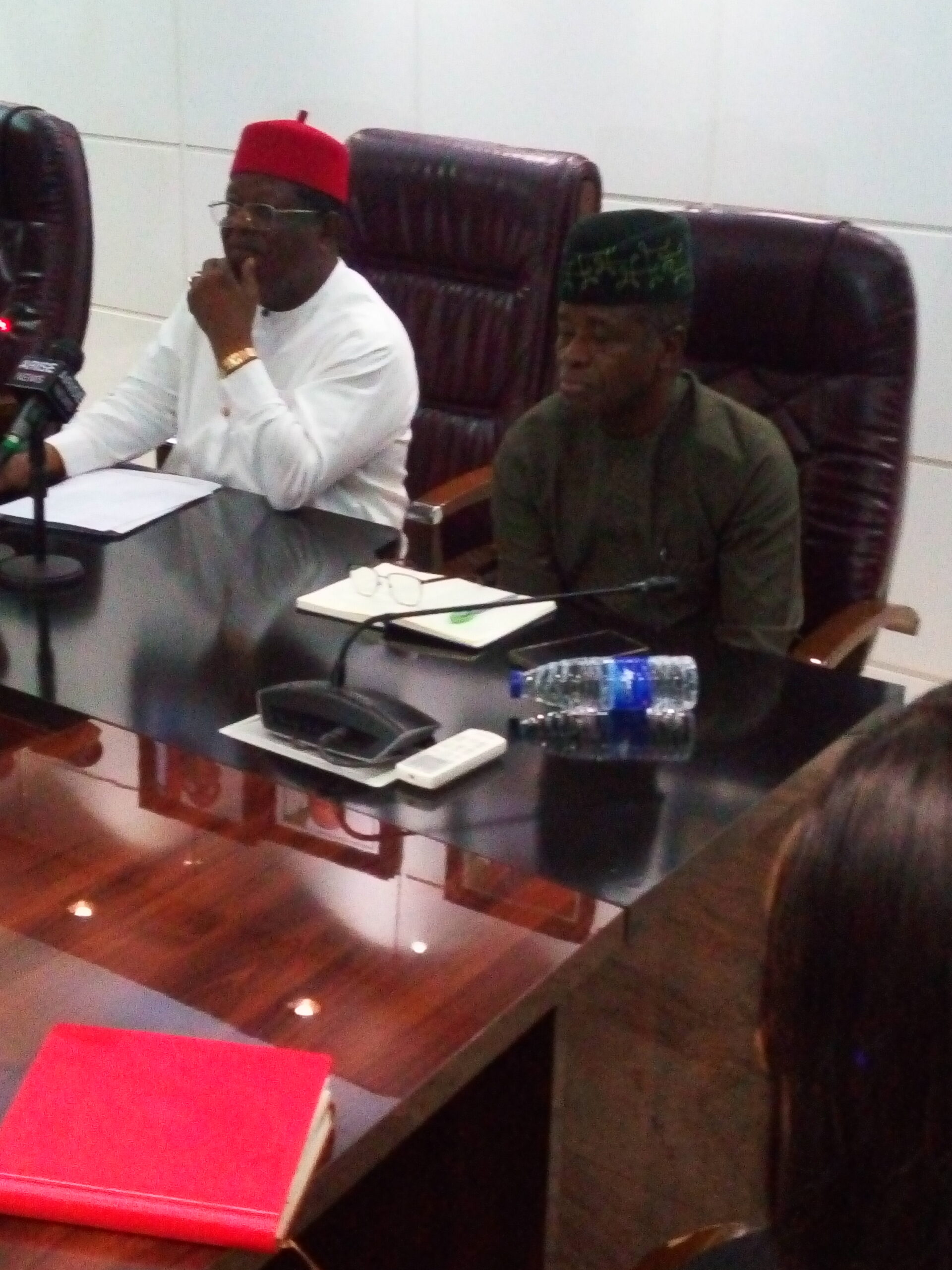
Nigeria’s Minister of Works, Senator David Umahi, used a press briefing in Abuja to lay out an ambitious slate of federal road projects accross the six geo political zones in the country.
While renaming the Lagos–Calabar Coastal Highway in honour of President Bola Ahmed Tinubu the Minister gave progress updates on several other multi-billion-naira legacy corridors.
According to him, the 750-kilometre coastal highway will now be known as the President Bola Ahmed Tinubu Coastal Highway, a decision he said he took using the powers of his office, in consultation with relevant stakeholders, to recognise a vision the president has held since his years as governor of Lagos State nearly three decades ago.
The minister also broke the coastal project into five active construction sections. The first, running from Victoria Island to a local village, spans about 47.47 kilometres and features dual carriageways built around a central 25-metre rail corridor. The second section, covering roughly 55 kilometres toward the Lagos–Ogun border, is about 60 percent completed and is targeted for handover by the end of November; it includes nine major bridges and flyovers, some with spans of up to 80 metres to accommodate heavy traffic near the Dangote Refinery. Further sections extend into Akwa Ibom and Cross River, Ogun and Ondo, and Akwa Ibom again, with completion levels ranging from 20 to 30 percent. Umahi said he expected the remaining stretches through Rivers, Bayelsa, Delta and Edo states to be finished in time for the president to inspect the completed corridor after the 2027 elections.
Beyond the coastal highway, Umahi presented three other projects he described as legacy undertakings. The Sokoto–Badagry Highway, first conceived more than five decades ago under the Shagari administration, is now under active construction along its 1,068-kilometre length, with sections between Ilela and Sokoto roughly 70 percent complete despite security challenges, and work ongoing on tree planting, solar lighting and CCTV installation along the route. Once finished, the minister said, the road is expected to cut travel time between Sokoto and Lagos to around ten hours.
He also detailed progress on a Trans-Sahara route intended to fully integrate the Southeast into national road networks, including an Ebonyi State beach access project that is over 40 percent complete, and a broader corridor expected to reduce travel time between the Southeast and Abuja to between two and four hours.
A fourth legacy project, running from Akwanga through Plateau, Bauchi, Gombe and Biu to Maiduguri, has already seen 125 kilometres procured and awarded to a joint venture, with President Tinubu recently approving an additional 400 kilometres that will bring the dualised project to 1,100 kilometres in total, passing through areas associated with former Head of State General Yakubu Gowon, the late politician Solomon Lar, and the current national chairman of the ruling All Progressives Congress.
On other fronts, Umahi announced presidential approval for the review and completion of the long-abandoned Imbi Bridge in Taraba State, originally awarded in 2018 and left roughly 40 percent complete, alongside design and procurement approval for a separate 5.76-kilometre bridge crossing in the same state. He said the Lagos–Ibadan Expressway would be reconstructed using reinforced concrete pavement engineered to last between 50 and 100 years without major maintenance, addressing recurring failures on the asphalt-based road. He further confirmed presidential approval for the dualisation of a 400-kilometre stretch of the East–West Road between Lokoja and Benin, along with an ongoing design review of the Third Mainland Bridge and a full replacement project already awarded for the Eko Bridge, with interim measures in place to keep the existing structure safe in the meantime.
Addressing criticism of the pace and cost of the projects, Umahi struck a defiant note, saying opposition to his ministry’s work only strengthens his resolve and draws more attention to what the administration has achieved. He insisted the projects were being delivered with integrity and would continue regardless of pushback, pointing to broader economic gains he attributed to improved roads, including stronger inter-regional trade, better security through CCTV surveillance and highway patrols, and faster emergency response times.
Taken together, the announcements reflect a administration betting heavily on road infrastructure as a centrepiece of its economic and political legacy, with the newly renamed coastal highway and the decades-old Sokoto–Badagry corridor standing as its most visible symbols of that ambition.











