





Apapa Customs sets collaborative tone as Mu’azu begins new Chapter

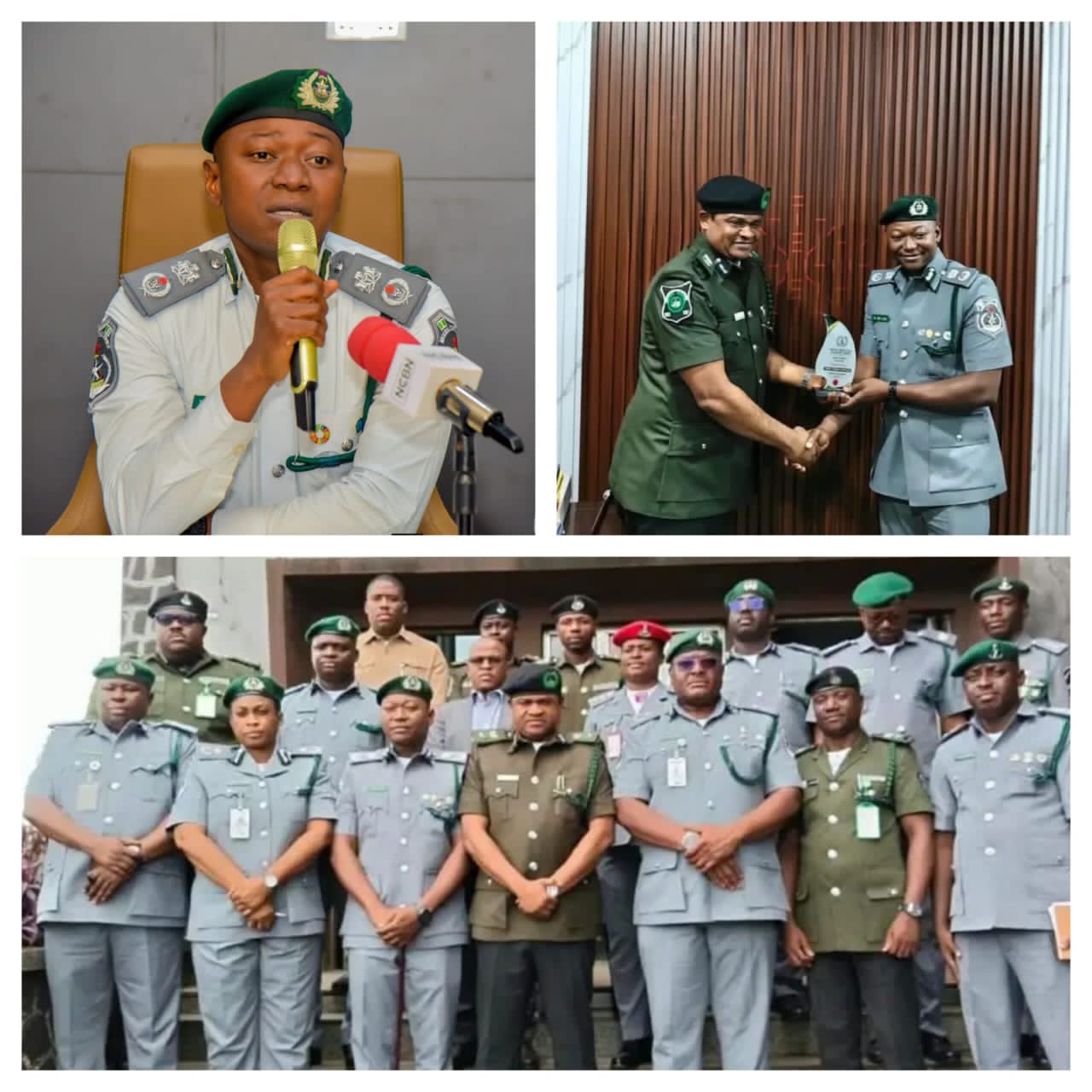
Apapa Customs sets collaborative tone as Mu’azu begins new Chapter
By Onu Okorie

At Nigeria’s busiest seaport, where revenue generation, cargo clearance, trade facilitation and border security converge, the early days of a new Customs Area Controller can set the tone for how efficiently the entire port ecosystem operates.
That appears to be the direction being taken by the new Customs Area Controller of the Nigeria Customs Service (NCS), Apapa Area Command, Comptroller Murtala Mu’azu, whose first engagements with critical stakeholders have placed collaboration at the centre of his administration.
Barely days after assuming office, Mu’azu has begun reaching out to agencies and operators whose activities directly affect the movement of cargo through Apapa Port, signalling an approach built around continuity, coordination and faster service delivery.
One of the early engagements was his courtesy visit to the Nigeria Agricultural Quarantine Service (NAQS) Apapa Command, where discussions focused on strengthening inter-agency cooperation in trade facilitation, border control, regulatory compliance and the protection of Nigeria’s agricultural sector.
The engagement is significant because the efficiency of cargo clearance at Apapa does not rest with Customs alone.
Every container moving through the port may pass through the hands of several government agencies, each with a distinct statutory responsibility. How effectively those agencies coordinate can determine whether legitimate cargo moves smoothly or becomes trapped in layers of inspection, documentation and regulatory requirements.
At the NAQS Apapa station, Station Commander, Comptroller G.A. Orumah, received Mu’azu and his team as both agencies reaffirmed the importance of working together.
For NAQS, the partnership has an additional dimension: ensuring that the growing volume of agricultural products entering and leaving Nigeria does not become a channel for introducing pests and diseases capable of threatening domestic agriculture.
Thus, while Customs is primarily concerned with revenue, enforcement and trade facilitation, NAQS operates on the sanitary and phytosanitary front, helping to protect the country’s crops, livestock and wider agricultural value chain.
Their responsibilities may be different, but at the port they intersect around one objective—making legitimate international trade more efficient while ensuring that regulatory and security standards are not compromised.
The NAQS engagement therefore offers an early glimpse into the kind of inter-agency relationship that could become central to Mu’azu’s tenure.
The new Apapa Customs boss officially assumed office on September 29, following the retirement of his predecessor, Comptroller Emmanuel Oshoba.
Rather than approaching the new assignment as a break from the past, Mu’azu has repeatedly emphasised consolidation.
At his stakeholder engagement, he acknowledged the gains recorded by the command in revenue generation, enforcement, compliance and trade facilitation, promising to build on the foundation inherited from his predecessor.
“The gains recorded in revenue generation, enforcement, compliance and trade facilitation are worthy of recognition. We shall consolidate on these achievements and build upon the foundation already laid,” he said.
That emphasis on continuity could prove particularly important at Apapa, a command that occupies a strategic position in Nigeria’s fiscal and commercial architecture.
The command is responsible for a significant proportion of the country’s maritime trade and revenue activities, making operational delays or disruptions capable of producing consequences far beyond the port environment.
Mu’azu has therefore aligned his administration with the policy thrust of the Comptroller-General of Customs, Adewale Adeniyi, built around consolidation, collaboration and innovation.
His early stakeholder engagements suggest that collaboration is not being treated merely as an administrative courtesy but as an operational tool.
The Customs Area Controller has also identified technical capacity as another area requiring attention.
He plans enhanced supervision and targeted training for Customs officers, particularly in tariff classification, valuation and fiscal policy, areas that directly affect revenue collection, compliance and the speed with which cargo disputes are resolved.
A review of demand-notice processing is also planned, alongside engagements with shipping lines and targeted training for Customs officers and port users.
These measures are aimed at addressing some of the practical issues that can slow down cargo processing and create uncertainty for importers and other participants in the maritime value chain.
For port users, the significance of such reforms lies in predictability.
A Customs administration that combines enforcement with clearer procedures, better-trained officers and stronger communication with shipping lines and regulatory agencies can potentially reduce avoidable delays without weakening controls.
Mu’azu has accordingly promised to pursue practical interventions while strengthening structures already in place.
“I therefore urge everyone to assist my team and me in delivering the mandate entrusted to us. I want to make it clear to the trading public that I am here to strengthen the foundations that have already been laid,” he said.
His words also place responsibility on stakeholders, suggesting that improved port efficiency will require cooperation from Customs, government regulators, shipping companies, terminal operators, importers, exporters and other participants.
The NAQS meeting reinforces that broader philosophy.
Agricultural imports, for instance, cannot be cleared efficiently if regulatory checks are conducted in isolation from the broader Customs process. At the same time, speed cannot come at the expense of biosecurity.
The challenge, therefore, is to build systems in which regulatory agencies share information, coordinate their activities and maintain their statutory responsibilities without unnecessarily duplicating processes.
For Nigeria, that balance has wider economic implications.
Apapa is not merely a gateway for cargo. It is an important artery for government revenue, industrial inputs, consumer goods and agricultural trade. The more predictable the port environment becomes, the easier it is for businesses to plan shipments, manage inventory and control logistics costs.
This is why Mu’azu’s early outreach may ultimately prove more important than the ceremonial nature of a familiarisation visit.
It represents an attempt to establish relationships before operational challenges become institutional disputes.
The NAQS engagement, in particular, points to a model in which Customs enforcement and agricultural biosecurity can work together rather than compete for operational space.
If sustained, such collaboration could strengthen compliance while supporting faster clearance of legitimate cargo.
For the new Apapa command, therefore, the first few days of Mu’azu’s tenure have produced a clear message: the immediate task is not to start afresh, but to strengthen what works, fix what slows trade and bring critical agencies closer together.
The success of that approach will ultimately be measured not by the number of stakeholder meetings held, but by whether cargo moves faster, revenue collection improves, compliance becomes stronger and businesses experience a more predictable Apapa Port.
That is where the new administration’s promise of consolidation, collaboration and innovation will face its real test.











