





Nigeria must keep oil, gas investment flowing amid energy transition — Ekpo

Nigeria must keep oil, gas investment flowing amid energy transition — Ekpo

By Onu Okorie
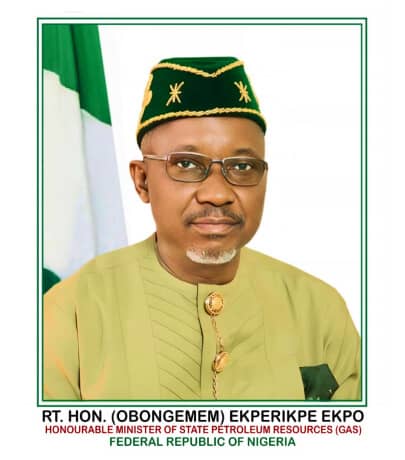
Nigeria must sustain investment in its oil and gas industry while gradually diversifying its energy mix to cope with the global energy transition, Minister of State for Petroleum Resources (Gas), Ekperikpe Ekpo, has said.
Ekpo said the country could not afford to abandon its abundant hydrocarbon resources at a time when millions of Nigerians still lacked reliable electricity and access to affordable and cleaner cooking fuels.
The minister spoke yesterday at the 2026 Annual Conference of the Association of Energy Correspondents Abuja (AECAF), held at Nicon Luxury Hotel, Abuja, with the theme, “Sustaining Oil and Gas Investment in Nigeria Amid Energy Transition.”
He said Nigeria’s energy transition must take into account the country’s development needs, noting that natural gas would remain central to meeting immediate energy requirements and supporting industrialisation.
According to him, Nigeria’s challenge is no longer simply about possessing large oil and gas reserves but about creating an investment environment capable of converting those resources into jobs, infrastructure, industrial growth and improved living standards.
He identified policy stability, regulatory certainty, fiscal competitiveness, security and efficient project execution as essential to sustaining investment in the petroleum sector.
“The challenge is to navigate this transition in a manner that safeguards energy security, promotes economic growth, attracts investment and ensures that our abundant natural resources continue to deliver value to our people,” Ekpo said.
PIA reforms, investor confidence
Ekpo said the Federal Government had taken steps to improve the petroleum investment climate, particularly through implementation of the Petroleum Industry Act (PIA) 2021 and reforms across the sector.
He said the reforms were designed to provide greater certainty for investors, strengthen regulatory institutions and make the industry more competitive.
The minister, however, said legislation alone would not be sufficient to attract capital, stressing that investors also needed assurance that government policies would be implemented consistently and projects delivered efficiently.
Gas takes centre stage
Ekpo said the government was positioning natural gas as a major driver of Nigeria’s economic development and energy transition.
He pointed to the Decade of Gas Initiative, which seeks to expand domestic gas utilisation across power generation, manufacturing, fertiliser production, petrochemicals, transportation and other productive sectors.
He also identified the Ajaokuta-Kaduna-Kano (AKK) and OB3 gas pipelines, alongside investments in gas processing, LNG and other midstream infrastructure, as critical to connecting the country’s gas reserves with domestic and international markets.
The government, he added, was promoting liquefied petroleum gas (LPG) and compressed natural gas (CNG) to improve access to cleaner and more affordable energy for households, businesses and industries.
“Millions of Nigerians still require reliable electricity and access to cleaner cooking fuels, while our industries require affordable and dependable energy,” Ekpo said.
“Natural gas therefore has an important role to play as a transition fuel and as an enabler of industrialisation.”
Bottlenecks threaten investment
The minister said sustaining investment would also require the government and industry operators to tackle persistent challenges, including inadequate infrastructure, insecurity, operational inefficiencies, lengthy contracting procedures and regulatory bottlenecks.
While government had a responsibility to provide an enabling environment, he said operators must also invest responsibly, improve efficiency and maintain high safety and environmental standards.
AECAF seeks balanced energy debate
Earlier, AECAF Chairman, John Ofikhenua, said the conference was convened to examine how Nigeria could sustain investment in its hydrocarbon industry as global energy priorities evolve.
Ofikhenua said oil and gas investment had historically been affected by adverse policy decisions, global economic shocks and changes in international energy strategies.
He cited the growth of shale production in the United States and the COVID-19 pandemic as developments that contributed to periods of uncertainty and declining investment in the global oil and gas industry.
He said the energy transition had further influenced investment flows, with some international oil companies divesting from Nigeria’s onshore assets.
However, Ofikhenua said subsequent disruptions in global energy markets had underscored the continuing importance of hydrocarbons to energy security.
He cited the Russia-Ukraine war and disruptions around the Strait of Hormuz as developments that had reinforced the strategic importance of reliable oil and gas supplies.
According to him, the global conversation is increasingly shifting towards achieving an energy mix rather than pursuing an exclusive focus on energy transition.
Security, policy stability critical
For Nigeria to benefit from renewed investor interest, Ofikhenua said the country must provide a predictable regulatory and policy environment.
He identified consistent implementation of the PIA, national security and policy stability as critical to retaining existing investors and attracting fresh capital.
“National security is very vital to oil sector investment drive,” he said, emphasising the need for a peaceful operating environment, particularly in the Niger Delta.
He also called for an end to what he described as policy “summersaults,” arguing that stable and enduring policies were necessary to strengthen investor confidence.
Ofikhenua pointed to renewed interest in Nigeria’s petroleum industry, including attention surrounding the Dangote Petroleum Refinery and Petrochemicals IPO and the Nigerian Upstream Petroleum Regulatory Commission’s oil and gas licensing rounds, as signs that investment opportunities remain attractive.
He said the priority now was to create the policy, security and regulatory conditions required to translate that interest into long-term investment.











