





Three years of transformation: how NASENI Is turning ideas into industries

Three years of transformation: how NASENI Is turning ideas into industries

By Onu Okorie
Three years after assuming office, the Executive Vice Chairman and Chief Executive Officer of the National Agency for Science and Engineering Infrastructure (NASENI), Mr. Khalil Suleiman Halilu, says the agency is moving beyond research and prototypes to build a system capable of turning Nigerian ideas into products, businesses, factories and jobs.
Marking three years of institutional transformation on Friday, September 4, 2026, Halilu said Nigeria had never lacked ideas or technical talent. What had been missing, he noted, was a connected system linking innovation to finance, manufacturing and the market.
“Nigeria has capable engineers, researchers and innovators. What has often been missing is a connected system that can identify promising ideas, develop them, finance them, manufacture them and take them to the market,” he said.
Under Halilu, NASENI has adopted a model built around three principles: Creation, Collaboration and Commercialisation. The agency creates and adapts technologies to meet national needs, works with partners to provide expertise and market access, and commercialises viable innovations.
In the last three years, NASENI awarded ₦229 million to 14 researchers under its Research Commercialisation Grant Programme, supporting projects in agriculture, clean energy, healthcare, mobility and digital security. It is also implementing DELTA-2, a Nigeria-Czech Republic initiative focused on applied research, experimental development and technology transfer.
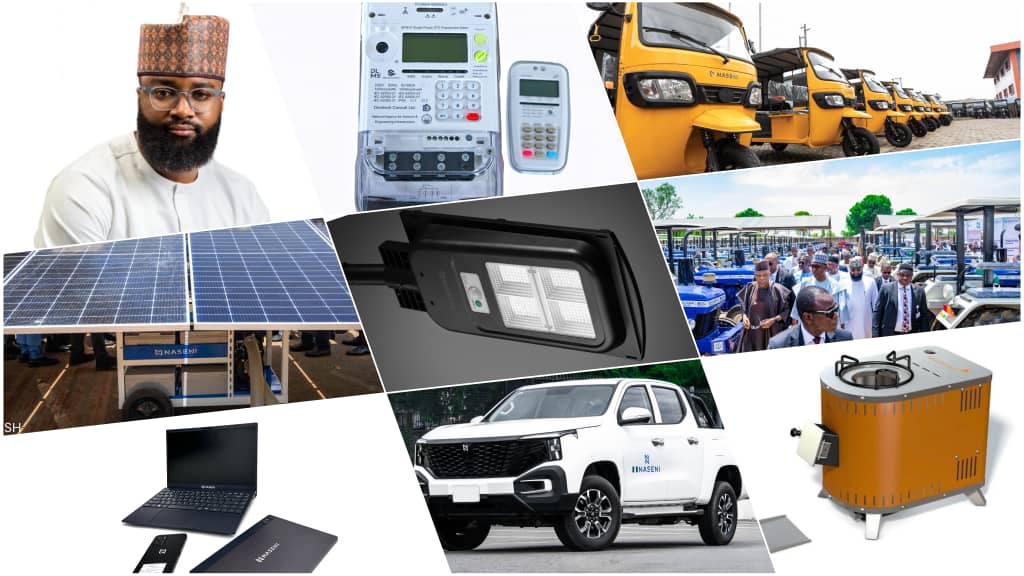
The agency says it has developed and introduced more than 40 products, spanning renewable energy, agriculture, healthcare, mobility, information technology, clean cooking and education. These include solar irrigation pumps, solar home systems, batteries, electric vehicles, electric tricycles, CNG conversion solutions, smartphones, laptops, diagnostic kits and clean cookstoves.
A major component of the transformation is infrastructure for local manufacturing. The 40-hectare Solar Industrial Park in Gora, Nasarawa State, is being developed as a platform for solar research, manufacturing, testing and deployment. NASENI DevFrontier is advancing local production of solar streetlights, while NASRacks is being established to manufacture solar mounting structures.
The agency is also working with local and international partners to build domestic capacity for photovoltaic modules, inverters, batteries and other renewable-energy components, with the goal of moving Nigeria from importing solar systems towards participating more deeply in the manufacturing value chain.
In transportation, NASENI is developing an electric vehicle assembly facility at Abuja Technology Village, including production of the NASENI Electric Keke. Its CNG conversion and reverse-engineering centres in Abuja are supporting cleaner and more affordable transportation while developing local technical capacity.
Agriculture has also received attention through the Irrigate Nigeria Project, which deploys solar-powered irrigation systems to support year-round farming. Another initiative is restoring idle tractors and machinery for productive use, while agricultural incubation centres at the University of Abuja and Bayero University Kano are being developed to support researchers, startups and young agripreneurs.
In healthcare, the NASENI-Troment Rapid Diagnostics Factory in Abuja is strengthening local production of medical diagnostic products. At the same time, the Centre of Excellence for Precision Manufacturing is building capacity to produce high-accuracy components for aerospace, automotive, electronics, renewable energy and medical-device industries.
Human capital development remains central to the strategy. Through FutureMakers, young Nigerians are being introduced to science, technology, engineering and mathematics, while SheFly and DELT-Her are expanding women’s participation in engineering and emerging technologies. Skills Acquisition Centres are also training Nigerians in areas such as solar technology, electrical installation and automotive maintenance.
NASENI has established more than 50 local and international partnerships, spanning renewable energy, agriculture, healthcare, automotive technology, defence, aerospace and research.
But Halilu says the number of projects and partnerships is not the ultimate measure of success.
“The real test is whether our products are adopted, our factories operate sustainably, our partnerships transfer useful capabilities, our trainees secure livelihoods and more value remain within the Nigerian economy,” he said.
Looking ahead, NASENI plans to scale commercial production, deepen local content, improve standards and certification, increase factory utilisation and expand market adoption.
“I do not want NASENI to be remembered simply as an agency that installed equipment or launched projects,” Halilu said. “I want it to be recognised as the institution that helped Nigeria build the capacity to manufacture what it needs.”
Three years into the transformation, NASENI is positioning itself as a connected national platform for technology transfer, manufacturing and commercialisation. While some projects are already operational and others remain under development, testing or commercialisation, the agency says its direction is clear: transforming Nigerian ingenuity into competitive products, skilled jobs and sustainable industries.
“Nigeria’s industrial future will be built through capable institutions, skilled people, competitive products and factories that produce. That is the system we are building at NASENI,” Halilu said.











