





Umahi: Tinubu’s infrastructure investment will transform Southeast economy

Umahi: Tinubu’s infrastructure investment will transform Southeast economy

By Onu Okorie
Minister of Works, Engr. David Umahi, has said the Federal Government’s ongoing road and bridge projects in the Southeast are designed not merely to improve transportation but to create economic corridors capable of reshaping commerce, employment and connectivity across the region.
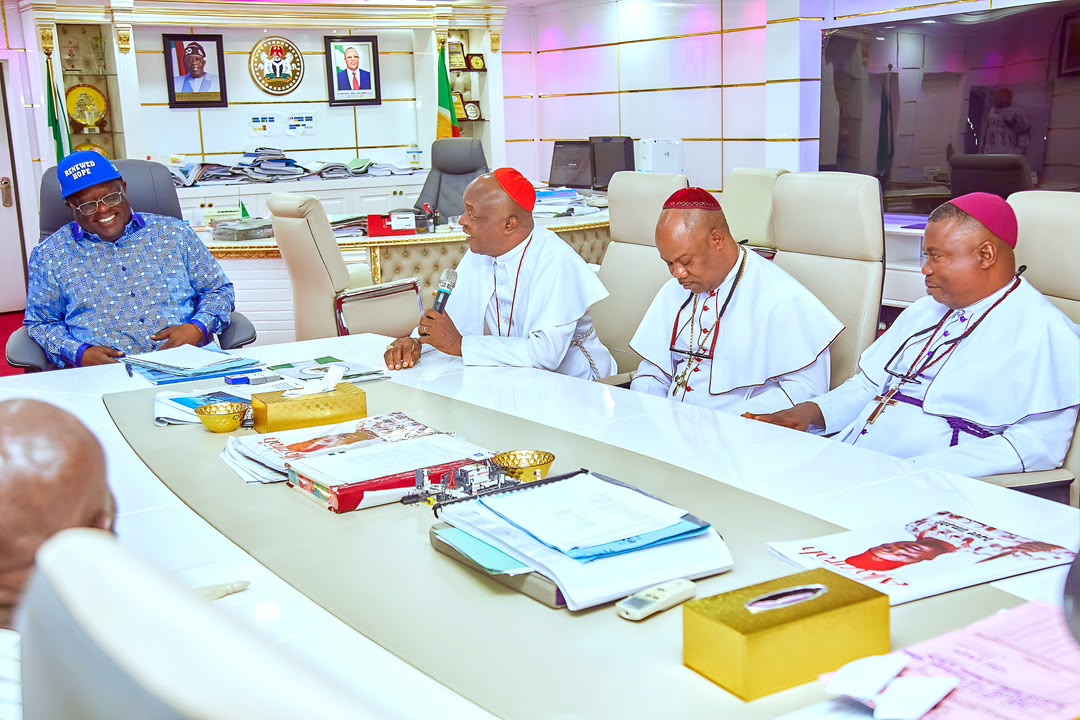
Umahi made the disclosure on Wednesday, September 23, 2026, when Bishops and Archbishops of the Methodist Church from the Southeast paid him a courtesy visit at the headquarters of the Federal Ministry of Works.
The minister said the scale of infrastructure investment under President Bola Ahmed Tinubu was intended to move Nigeria beyond the construction of individual roads towards an integrated network that would stimulate economic activity along major transportation corridors.
“When we finish, then we will now build infrastructure along the corridor. Nigeria will never be the same again,” Umahi said.
He explained that the Federal Government’s decision to invest in roads and other infrastructure was an economic strategy, arguing that the benefits extended beyond shorter travel times to job creation, improved security, increased commercial activity and broader economic growth.
“We are borrowing to put in infrastructure, and this infrastructure, it is an investment,” he said.
According to the minister, improved roads could shorten distances between communities, facilitate the movement of goods and people and open up areas for new businesses and industries.
“It is also fighting insecurity. It’s shortening the distance between communities. It’s creating a revolution in our GDP and then commercial activities,” he said.
Southeast Projects
Umahi highlighted several major projects in the Southeast which, he said, would have significant implications for regional connectivity when completed.
Among them are the Enugu-Port Harcourt Road, Enugu-Onitsha corridor, Enugu-Abakaliki Road, Eke-Obinagu Flyover in Enugu and the Second Niger Bridge.
He said the reconstruction of the Enugu-Port Harcourt Road would address a longstanding transportation challenge, noting that travellers had previously spent several hours covering the route.
“In Enugu-Port Harcourt, for more than 18 years, nobody has spent less than seven hours to do that short journey,” he said.
The minister said sections of the road were now being reconstructed with reinforced concrete pavement as part of efforts to deliver more durable infrastructure.
He also pointed to the Eke-Obinagu Flyover, saying motorists who previously encountered lengthy traffic delays in the area could now use the completed structure.
Umahi further disclosed that rehabilitation work on the First Niger Bridge was nearing completion following concerns over its condition.
He said President Tinubu had directed that the bridge be shut when the structural concerns emerged, allowing rehabilitation work to proceed.
“When we heard of the First Niger Bridge, the President immediately directed that it should be shut down,” he said.
According to the minister, the rehabilitation was being undertaken continuously and the bridge was expected to be commissioned with solar lighting and CCTV surveillance.
He compared the standard of the rehabilitated bridge to that of the Third Mainland Bridge.
New Highway Corridor
Umahi also disclosed progress on a major highway corridor linking Calabar through Ebonyi, Benue and Enugu to Kogi and onward to Abuja.
He said the first two sections, covering approximately 330 kilometres, had already been awarded and paid for by the Federal Government.
The minister said the project, when completed, would substantially reduce travel time between parts of the Southeast and Abuja.
“Those from Enugu can join at Nsukka Axis, and then they will now be in Abuja within three hours,” he said.
“For those of us in Ebonyi, we can be in Abuja within four hours,” he added.
Umahi said the projects demonstrated the importance of viewing infrastructure as an investment rather than simply government expenditure.
He said the roads would create opportunities for businesses and communities located along the corridors, while also improving access between major population and commercial centres.
‘We Need More, But We Must Recognise Progress’
While acknowledging demands for additional development in the Southeast, Umahi said the region should also recognise projects already under construction.
He said previous concerns about marginalisation should not prevent citizens from acknowledging current federal investments.
“Yes, I agree that in the past there was so much marginalisation of the Igbo everywhere, not just the Southeast, but President Bola Tinubu has changed the narrative,” he said.
He urged Nigerians in the region to continue demanding more infrastructure while recognising ongoing projects.
“We can be looking for more. I agree. We can demand more so that we can meet up with the past marginalisation, but it shouldn’t make us not be appreciative,” he said.
Using the biblical account of the ten lepers healed by Jesus Christ, Umahi said appreciation and continued pursuit of development could coexist.
He also appealed to church leaders and other stakeholders to educate citizens, particularly young people, about the infrastructure projects and the economic opportunities they could generate.
Methodist Church Commends Projects
The Methodist delegation, led by the Methodist Church Archbishop of Anambra State, Most. Revd. Dr. Vincent C. E. Onoh, commended the Federal Government and Umahi for infrastructure development in the Southeast.
Onoh said the delegation had visited the minister to express appreciation for projects being undertaken across the country, particularly in the Southeast.
“Sometimes people wouldn’t even know where we start when we want to talk about you, but we have just come as a church to appreciate you for the work you are doing, not only in entire Nigeria, but particularly in the Southeast,” the Archbishop said.
He specifically praised the progress of work on the Niger Bridge, saying the project was about 90 per cent completed.
The Archbishop said the scale of the infrastructure had impressed visitors who had seen the project, adding that the Methodist Church recognised Umahi’s contribution to infrastructure development.
He recalled Umahi’s record as governor of Ebonyi State and announced plans for a prayer and sensitisation programme that would begin in Awka and extend to Enugu, Ebonyi and Imo states.
The initiative, he said, would focus on spiritual renewal and sensitisation, with major gatherings expected to attract more than 5,000 people.
Beyond Roads
Umahi said the Federal Government’s long-term objective was to use infrastructure as a foundation for wider economic development.
He argued that the value of a road should ultimately be measured not only by the distance it connects but also by the economic activity it enables.
The minister said infrastructure development could support employment, strengthen security, facilitate commerce and attract investment to communities along major corridors.
He therefore urged church leaders and other community stakeholders to help communicate the potential benefits of the projects to citizens.
“What we are looking for is infrastructure, appointments, development, good governance,” he said.
Umahi also commended governors in the Southeast for what he described as their cooperation with the Federal Government, saying their experience in public administration had enabled them to appreciate the importance of collaboration between the federal and state governments.
He said his immediate priority was to ensure that projects already initiated were completed.
“I said I’m on the ballot. When the President has won, I have won,” he said. The minister added: “If these projects are completed, we will never be the same again.”











