





FG, CBN seal Fiscal-Monetary pact to tackle inflation, strengthen economic stability

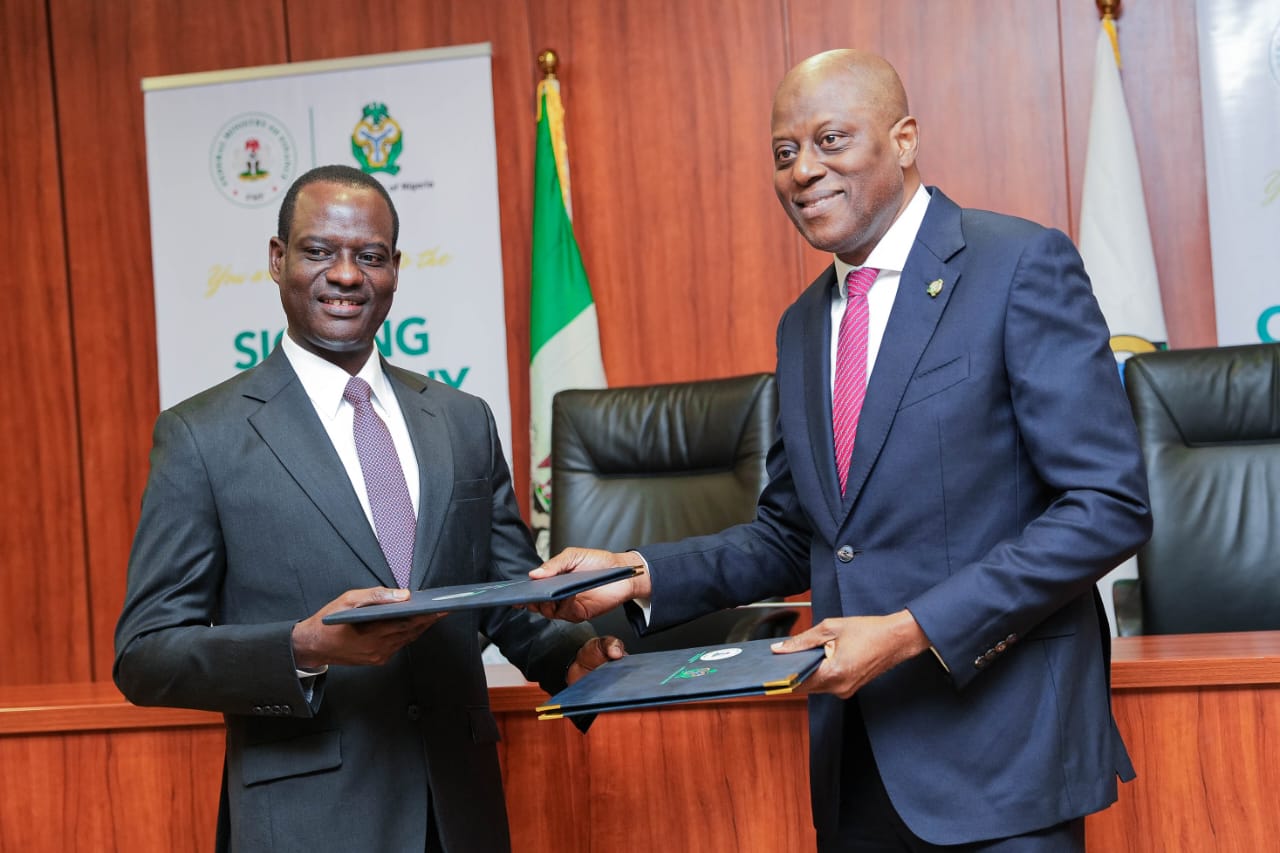
FG, CBN seal Fiscal-Monetary pact to tackle inflation, strengthen economic stability

By Onu Okorie
Federal Government and the Central Bank of Nigeria (CBN) have formalised a new framework for closer fiscal and monetary policy coordination, with inflation control, policy consistency and macroeconomic stability emerging as key priorities.
The framework, sealed through a Memorandum of Understanding (MoU) between the Federal Ministry of Finance and the apex bank, is designed to institutionalise regular consultation, information sharing and coordinated economic forecasting.
Speaking at the signing ceremony in Abuja, the Minister of Finance and Coordinating Minister of the Economy, Taiwo Oyedele, said the agreement would move fiscal-monetary coordination beyond individual relationships and make it a permanent feature of Nigeria’s economic management.
He stressed that although the Ministry and the CBN have separate mandates and must retain their institutional independence, their policies ultimately affect the same economy.
According to him, government borrowing has implications for liquidity, interest rates and financing costs, while monetary policy decisions also have consequences for government finances.
He added that exchange rates, tariffs, government spending and agricultural policies could directly influence inflation, government revenue and economic activity.
Oyedele identified the sustainable reduction of inflation to single digits as a major objective of the new framework, arguing that the target could not be achieved through monetary policy alone.
He said the Ministry of Finance would contribute through fiscal discipline, sound cash and liquidity management and more efficient government financing, while fiscal interventions would address structural sources of inflation, particularly food, energy, imported costs and logistics.
On food inflation, the minister said the government would work with relevant institutions and state governments to strengthen grain reserves, improve agricultural yields and irrigation, enhance climate resilience and tackle gaps in farm-to-market infrastructure.
Oyedele also ruled out a return to fuel subsidy, warning that such a move would put additional pressure on public finances and the naira.
He said improved foreign exchange stability and tax exemptions on fuel had contributed to moderating prices.
The minister further identified improved economic data as critical to effective policy coordination, disclosing that the Ministry was working with the National Bureau of Statistics (NBS) to expand the quality and range of data available for economic policy decisions.
Under the new framework, the Ministry and the CBN will strengthen information sharing on government cash positions, financing plans, credit growth and foreign exchange flows.
“Better coordination starts with a common evidence base,” Oyedele said.
The minister said recent economic developments indicated stronger confidence in the Nigerian economy, citing a balance of payments surplus of more than $5 billion in 2025 and external reserves exceeding $54 billion.
He also pointed to increased non-oil exports, declining refined-product imports as domestic refining capacity expands, Nigeria’s return to Frontier Market status and its inclusion in JPMorgan’s new frontier local-currency government bond index.
However, Oyedele said the government’s objective extended beyond attracting short-term portfolio inflows to securing patient capital capable of financing factories, infrastructure, technology and job creation.
He said this would require policy consistency and certainty, as well as a regulatory environment that avoids unnecessary burdens on businesses.
The framework, he added, would also consider the economic consequences of insecurity and illicit financial flows.
Oyedele said the Ministry would continue to focus on fiscal discipline, improved liquidity management, greater transparency, stronger data systems, more efficient financing and reforms aimed at boosting production and easing structural inflation.
“Nigeria has one economy. Fiscal policy cannot succeed without price stability; monetary policy cannot deliver price stability if fiscal policy pulls in the opposite direction,” he said.
The CBN Governor, Olayemi Cardoso, described the agreement as a significant step towards strengthening Nigeria’s macroeconomic management and economic stability.
Cardoso said fiscal and monetary policies were complementary instruments whose combined impact would be stronger when implemented in harmony.
He clarified that the MoU did not establish a new relationship between the two institutions, noting that the CBN and Ministry of Finance had collaborated for decades on inflation management, debt sustainability, budget financing, exchange-rate stability and responses to economic shocks.
Rather, he said, the agreement formalised the longstanding collaboration through structured processes for regular consultation, information exchange and policy coordination.
Under the arrangement, cooperation would be strengthened in areas including government cash management, debt issuance planning, liquidity forecasting, macroeconomic analysis and periodic policy consultations.
Cardoso said the timing was particularly important as the CBN advances its transition towards an inflation-targeting framework, whose effectiveness, he noted, also depends on a supportive fiscal environment.
He commended Oyedele and the technical teams from both institutions for bringing the initiative to fruition, reaffirming the CBN’s commitment to sound monetary policy, macroeconomic stability and financial system resilience.
He expressed confidence that the strengthened partnership would contribute to building a more stable and resilient Nigerian economy capable of creating greater opportunities for citizens.











